S u s t a i n a b l e R e v i t a l i z a t i o n P r o p o s a l
569
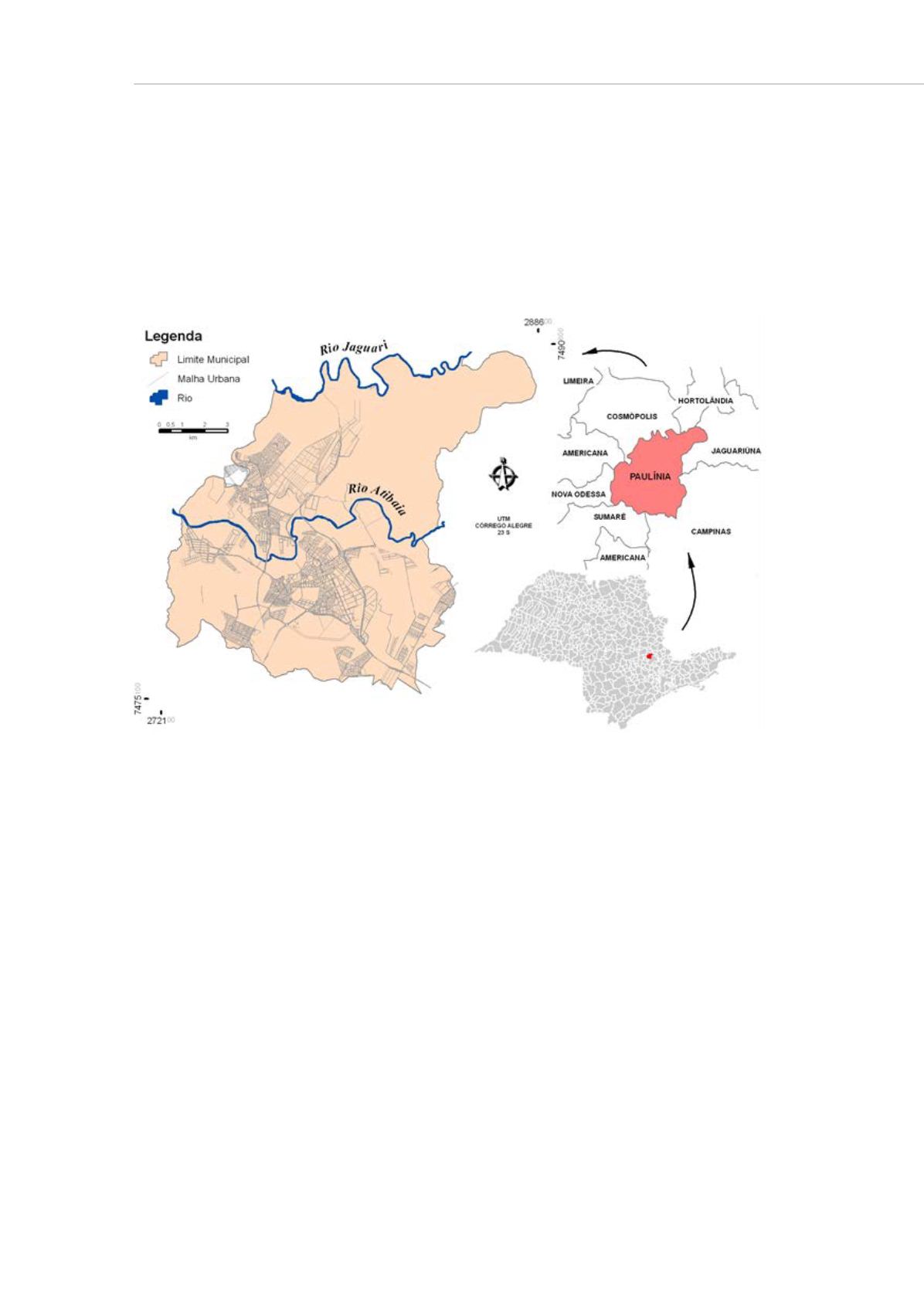
Odessa, Americana and Sumaré (Fig.2) Paulínia is 154 Km² large, being 98 Km² its
urban area and 56 Km² its rural area. Its population numbers 84.000 inhabitants.
Economically, Paulínia has several petrochemistry and byproducts industries, due the
establishment of one of the largest Brazilian’s oil refinery (REPLAN) in the 1970s.
Two large rivers run through the city, Atibaia and Jaguari (Fig. 2). These rivers
are Piracicaba’s affluent, this one flows into Tietê river, one of the mainly Paraná’s
affluent.
Figure 2: Paulínia’s localization map.
Paulínia’s original vegetation covering was mainly forest, represented by
Atlantic Forest. Paulínia is located in an ecological tension zone due to different
vegetation’s physiognomy contacts. Being: Savanna (
Cerrado
), Seasonal
Semideciduous Forest (Floresta Estacional Semidecidual) and Ombrophylous Forest
(Floresta Umbrófila) (Fig.3). Areas of ecological tension are the contact of two
phytoecological regions, when an interpenetration of species in their environments
promotes two situations: a species’ mixture forming ecotones or contact in an enclave
way. In the second case, each formation save its ecological identity without mixture
(UNIEMP 2003).
Nowadays, Paulínia’s landscape has both urban and rural characteristics,
constituting a heterogeneous mosaic of urban stains, pasture, annual and perennial
cultures, reforestation and vegetation’s remains (Fig. 4).


