Z E M C H 2 0 1 2 I n t e r n a t i o n a l C o n f e r e n c e
558
symbolic meaning, related to the great shifts of the time. The artifacts that compose the
railway complex can be considered therefore as attestations of an historical memory that
certifies the contamination of building typologies imposed by the central seat of
government with the materials and the local techniques. In fact Central government
gives some typological indication for the construction of railway buildings, for Sicily the
local government was the so called "Technical Governmental Direction of Sicilian
Railway". The will to retrain the adjoining spaces to these industrial artifacts, considering
the “railway complex” as a new center of aggregation and culture, has been a recently
discussion point both on a regional scale and a on a national scale. Now more and more
disused railway construction found a new destination in social and cultural field.
Otherwise halls of residences – as provided in regulations - must provided for cultural
and didactic services (to function as study, research, documentation, reading, meeting
and community center, hobby, non-institutional cultural formation, socialization) assured
only by a campus of new construction or the reutilization of a building complex with a
structured organization. It seems now like an obsolete and unproductive idea to opt for
“dorm buildings” split off from a connective tissue that allows them to be part of a
community, the university community. Therefore the final choice has been to achieve a
Center of sustainable science, in which coexist, like Chinese puzzles, different related
“micro-towns”: in the first place the railway station, that keeps and develops its functions,
then the residence campus, that includes the three ex-residential buildings for the
exclusive use (residence and canteen), and in the end a Centre of technological
knowledge. This is a group of buildings designed for cultural services and aggregation,
for the prevalent use of the university complex, but also including the external users.
The hybrid organization structures constitutes a further resource, which aim is to achieve
spaces that shouldn’t be considered – as is bad habit – as white elephants, but
otherwise could be real cultural workshop, supported by the academic Intelligentia.
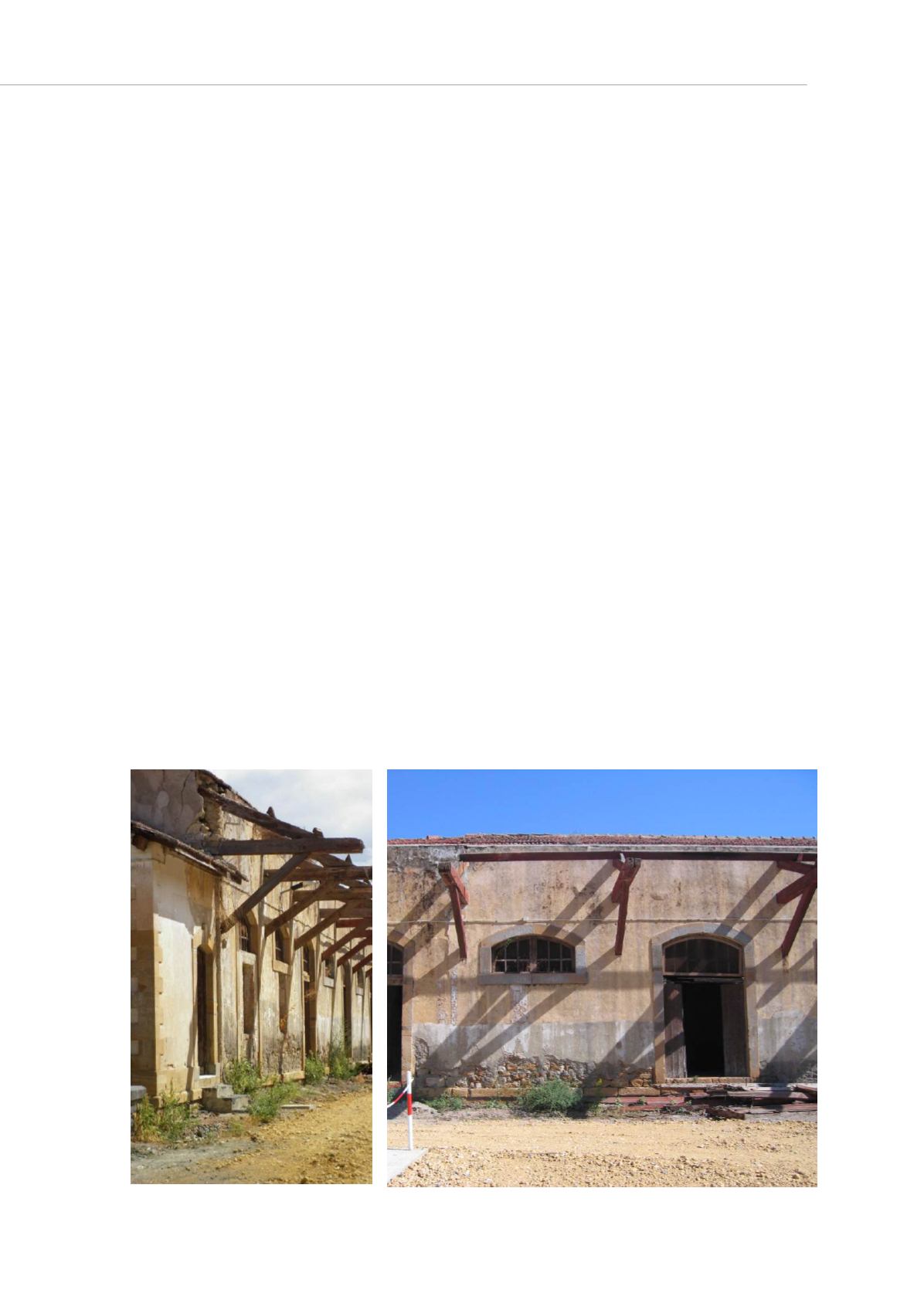
Among the hybrid organization structures is certainly included the warehouse (fig. 3),
coeval to the first structure of the passengers buildings. The industrial artifact –
completely abandoned at the present time – in the thirties went through extension works
that changed the planimetric structure alignment, achieving a prolongation in the parallel
direction to the railway lines, designed for offices and for the classification of goods.
Except for these evident intervention, overall the structure presents again the
Figure 3 : The warehouse


