Z E M C H 2 0 1 2 I n t e r n a t i o n a l C o n f e r e n c e
254
Many buildings belonging to the Mediterranean and Middle Eastern architecture were
designed using architectural features for climate control. The architecture of Maghreb
and Middle East area is particularly rich of these examples, since the very hot and dry
climate requires a mitigation of its effects to improve the living conditions in indoor
environments. Most of the dignified and representative buildings, such as royal palaces,
have a lot of systems and techniques for passive cooling, such as solar radiation control,
for example in Mashrabiya or Claustrum systems; ventilation and cooling control, as for
Malqaf, clerestories, Badgir or Dur-Qa'a / Iwan systems.
In this context was very important also the diurnal control of the heat through the building
mass envelope. In almost all buildings in the Middle East this was associated with a
room (often barycentric and with an important symbolic meaning for social life) whit a
water basin or a fountain: the
Salsabil
.
This system allowed to cool and humidify the air by means of water evaporation.
Therefore beneficial effects were obtained for the interior comfort especially in a dry
climate like the Middle Eastern one.
A concept of Arab building in Palermo: Zisa Complex
The integration of passive systems in Middle Eastern representative building had an
excellent application also in Arabic - Norman architecture in Sicily, especially in the
Zisa’s building complex, in Palermo.
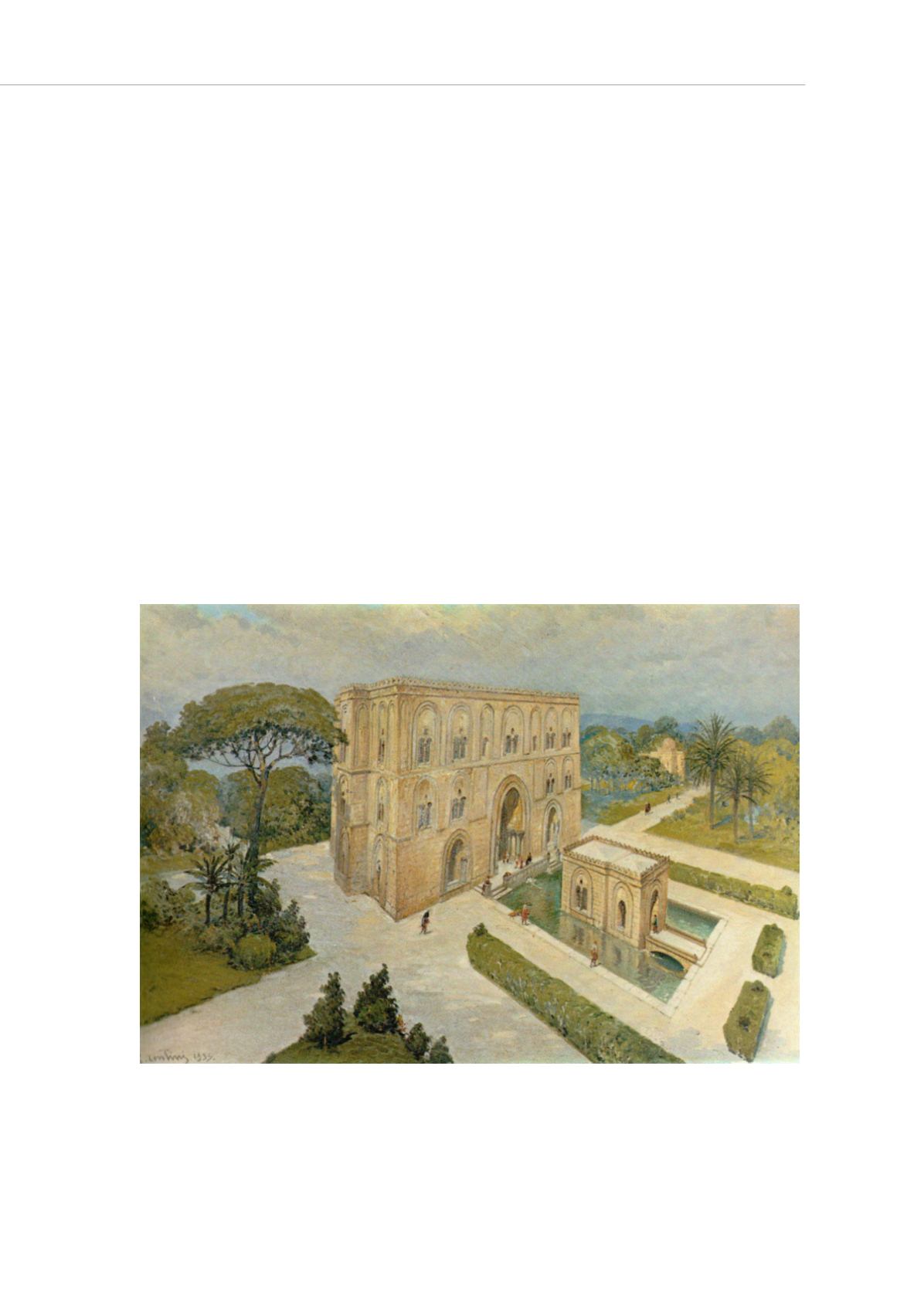
It was built in 1160 by Arabian craftsmen (Fig.1). It was characterized by the presence of
an evaporative cooling system and natural ventilation that guaranteed levels of comfort
that could be satisfactory even nowadays.
Figure 1
: Ideal reconstruction of Zisa, a painting by Rocco Lentini (1935)
The current state of Zisa complex is the result of heavy tampering since Fourteenth
century, when it was transformed into a fortified castle, with also some small changes,
such as the creation of a crenelated crown. Later it was used as a beam agriculture and
left for centuries in a state of total decay. In 1634 the building, for its poor conditions,


