A n a l y s i s o f t h e T r a d i t i o n a l P a s s i v e S y s t e m s
259
breeze, which is generated in those hours (Fig.4). It comes from East and it is
considered with low intensity (0.5 m/s) and an initial temperature of 25°C, in order to
analyze the model under the most unfavorable conditions.
With regard to the building, the rubble-filled stone wall has been schematized by setting
a material whose thermo-physical properties are the weighted mean between real
materials values.
Particularly, density (1306kg/m
3
), specific heat (1362J/kgK) and thermal conductivity
(0.64W/mK) have been considered. Air has been schematized according to Bousinnesq
density model (1.225kg/m
3
), with a thermal expansion coefficient of 0.003
Salsabil
main action consists of water particles nebulization due to the roughness of
surface. It has been simulated by creating a surface injecting water particles with a
diameter of 10
-4
mm, with a flow rate of 0.5kg/s and with a speed of 0.1m/s.
In the software the temporal development of the phenomenon is not-continuous,
therefore the simulation considers "time steps" lasting three hours.
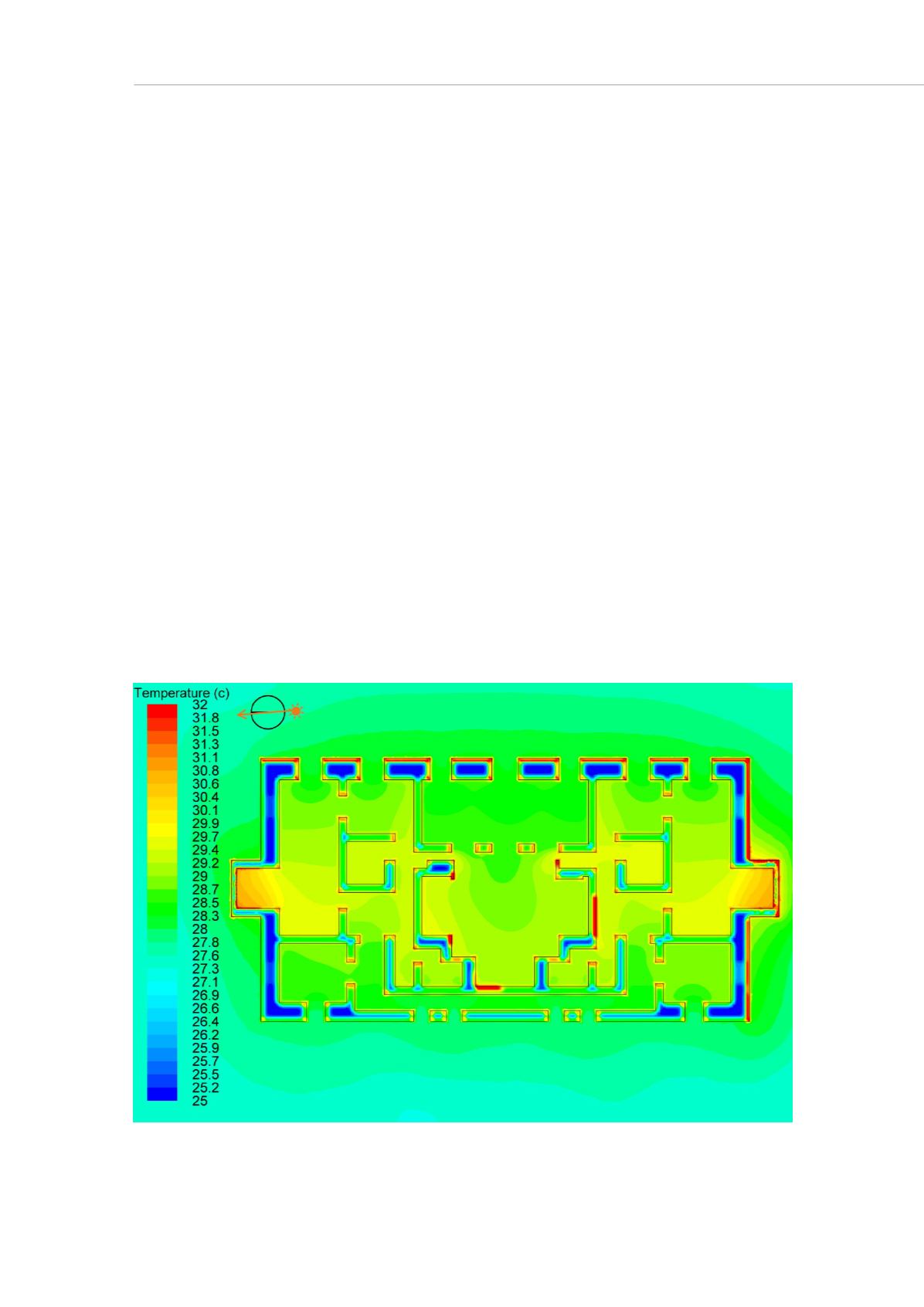
Looking at the results obtained at 12 a.m. and at 3 p.m., it can be observed that solar
radiation heat on exposed surfaces cannot entirely conduct itself through the wall, but
affects only the outer portion.
The wall dissipates heat, due to radiation, during the day and acts as an insulator,
thanks to the constituent material features, but more importantly thanks to its high thick:
only the thinnest walls (40cm) on the South side are completely traversed by heat,
because they had already underwent solar irradiation over nine hours (Fig.9-10).
With regards to the effects of natural ventilation, in the daily hours with no wind (6-12
a.m.), it can be observed that a natural ventilation rises up in the rooms. It happens
because of the thermal gradient which is established between external and internal
environments. It is more evident in the rooms on the East front of the building, which
undergoes only a soft radiance in the morning. It is shady during afternoon hottest hours
and is cooled by the basin, the “
peschiera
” (Fig.11-12).
Figure 9
: 12 a.m., temperature on second floor


