Z E M C H 2 0 1 2 I n t e r n a t i o n a l C o n f e r e n c e
340
b)
CO
2
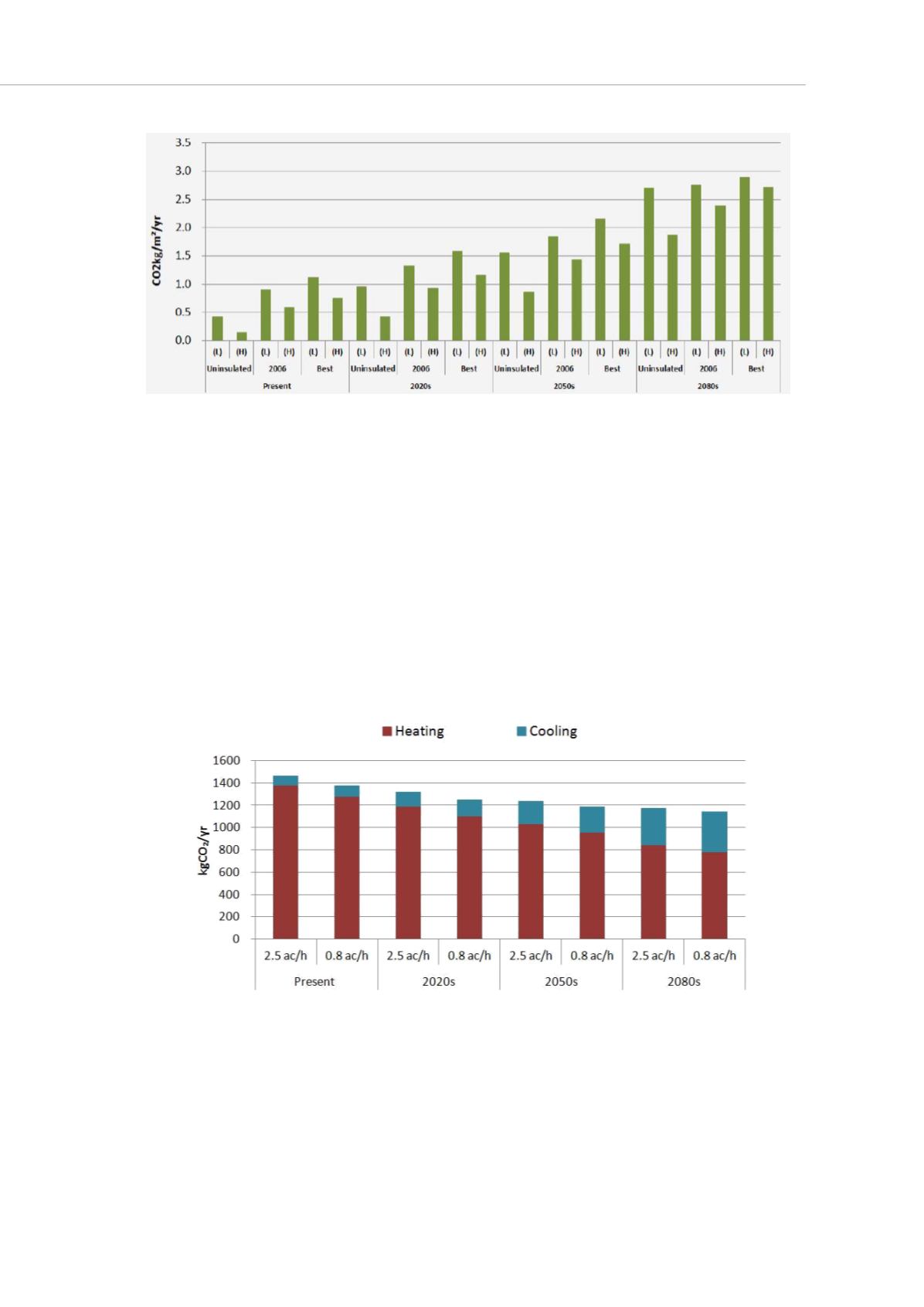
emissions from cooling by various construction methods.
Figure 7. CO
2
emissions by various construction methods.
d) Study D - Sensitivity to Ventilation Rate
In dwellings, lowering ventilation rate can reduce some of the heating demand while
cooling loads are slightly increased or stable. Overall, this achieves a reduction in carbon
emissions (see Figure 8). This is important to establish as ventilation rate in simulation is
not a realistic input since it remains a constant fixed value during operating hours. The
input to the model achieved an overall ventilation (infiltration with natural ventilation) rate
of 2.5 air changes per hour (high) and 0.8 ac/h (low). Consistent gas consumption
reduction of around 7% is seen at throughout the weather scenarios when comparing
results from the low and high ventilation rate model. As increased external temperature
and decreased ventilation rate, the electricity consumption loads are increased. However,
the heating load reduction and the cooling load increase are mainly related with
increasing external temperatures rather than changing ventilation rates. However, this
would not ignore some of the impact on carbon dioxide emissions.
Figure 8. CO
2
emissions from sensitivity to ventilation rate
.
Conclusion
In the UK, more than a quarter of energy consumption is caused by the housing sector
due to space and water heating, cooking, appliances and lighting. The UK government
has focused on new build homes and set very ambitious targets where the new homes
will be zero carbon after 2016 and 80% GHG emissions reduction by 2050 for national
levels. Thus, existing homes will continue to be majority percentage of the UK housing
stock by 2050 and efforts need to focus on improving existing homes in order to achieve


