S u s t a i n a b l e R e v i t a l i z a t i o n P r o p o s a l
571
Bufo 2005, qualified the vegetation remains of the municipality as Seasonal
Semideciduous Forest (Floresta Estacional Semidecidual), Riverside Seasonal
Semideciduous Forest (Floresta Estacional Semidecidual Ribeirinha), Swamp Forest
(Floresta Paludosa), Wet Fields (Campos Úmidos) and Savanna (Cerrado).
The main characteristics of these forests formations are presented below:
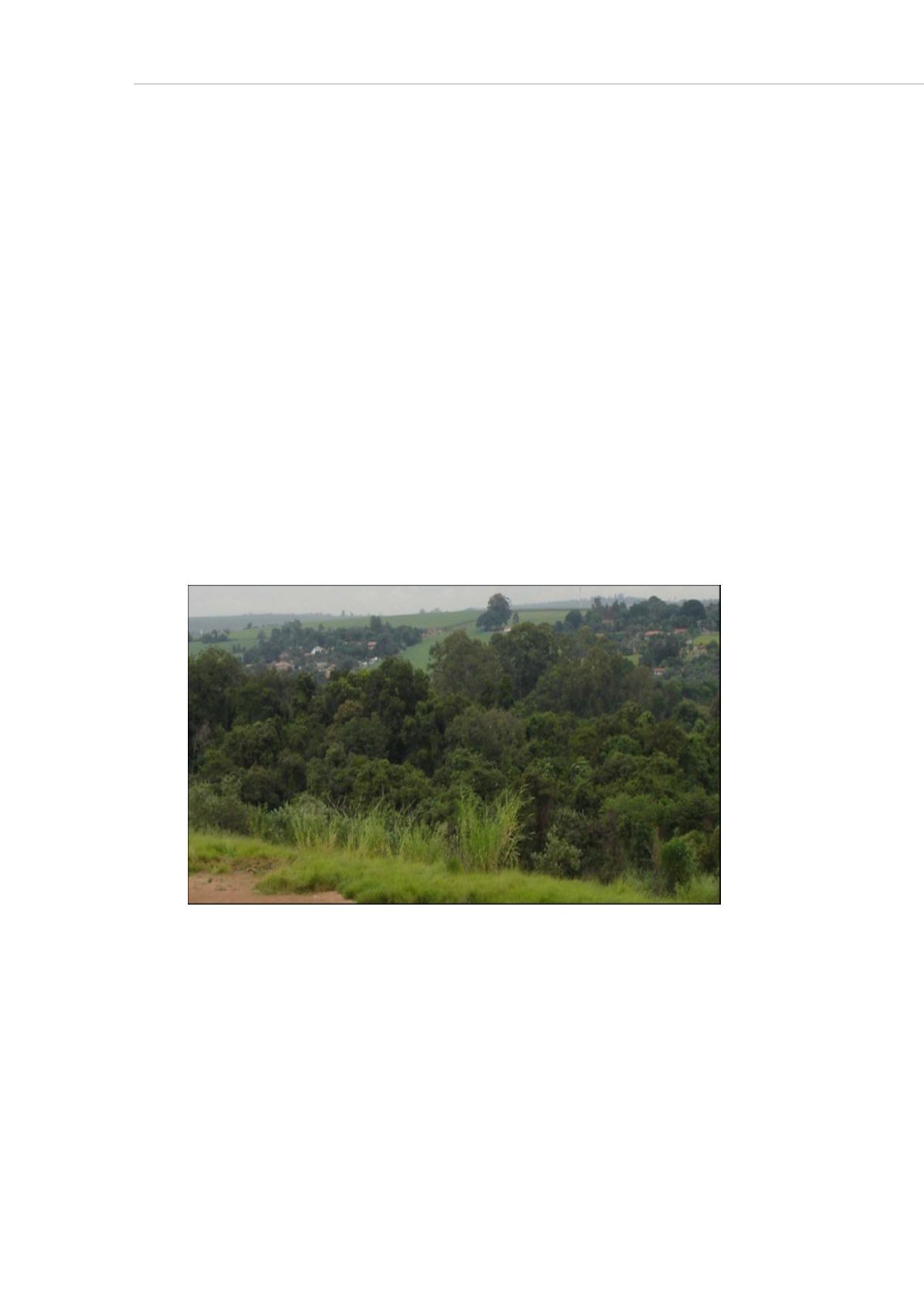
Seasonal Semideciduous Forest
(Floresta Estacional Semidecidual) (Fig. 5),
also denominated interior’s Atlantic Forest is one of the forest’s subgroup which
composes the Atlantic Forest, especially in the Serra do Mar west regions. What
characterizes this type of forest and names it is the fact that the trees are composed
largely of deciduous species, i. e., has deciduous leaves, which fall
in the dry season in
response to the peculiar water scarcity during winter months in much of the interior of
Brazil. In São Paulo, the total area of this remaining forest type corresponds currently
to less than 5% of what existed in the late nineteenth century, and the type of
vegetation that was more severely destroyed to make way for agriculture (Ramos
2008).
The ecological concept of this type of vegetation is subjected to double
seasonal climate, a tropical season with heavy summer rainfall, followed by severe
drought and other subtropical with a non-dried period, but with physiological drought
caused by the intense cold of winter, when temperatures averages are below 15 º C. In
this type of vegetation the percentage of deciduous trees as a forest (and not in others
species that lose their leaves individually) is between 20 and 50% (Veloso 1992).
Figure 5. Seasonal Semideciduous Forest (Floresta Estacional Semidecidual) in Paulínia,
São Paulo, Brazil.
Riverside Seasonal Semideciduous Forest
(Floresta Estacional
Semidecidual Ribeirinha)
(Fig. 6), occurs in restricted areas along watercourses, in wet
soils or sites subject to periodic flooding. Such conditions, coupled with constancy and
time of flooding, determine the characteristics of these forests, distinguishing them from
other non-moist environment (Leitão-Filho 1982).
In its floristic composition, riparian forests often are influenced by other
vegetation species that adapt. Often there is an abrupt transition to grassland or
savanna formations. Most species of this composition have no falling leaves in the dry


