Z E M C H 2 0 1 2 I n t e r n a t i o n a l C o n f e r e n c e
156
understanding strength and weakness of a software/tool and the availability of such kind
of data was the main criterion used for the case studies selection.
The first case study was Palazzo Kofler, built at the beginning of the 20
th
century,
retrofitted three years ago with the ClimateHouse standard and subjected to monitoring
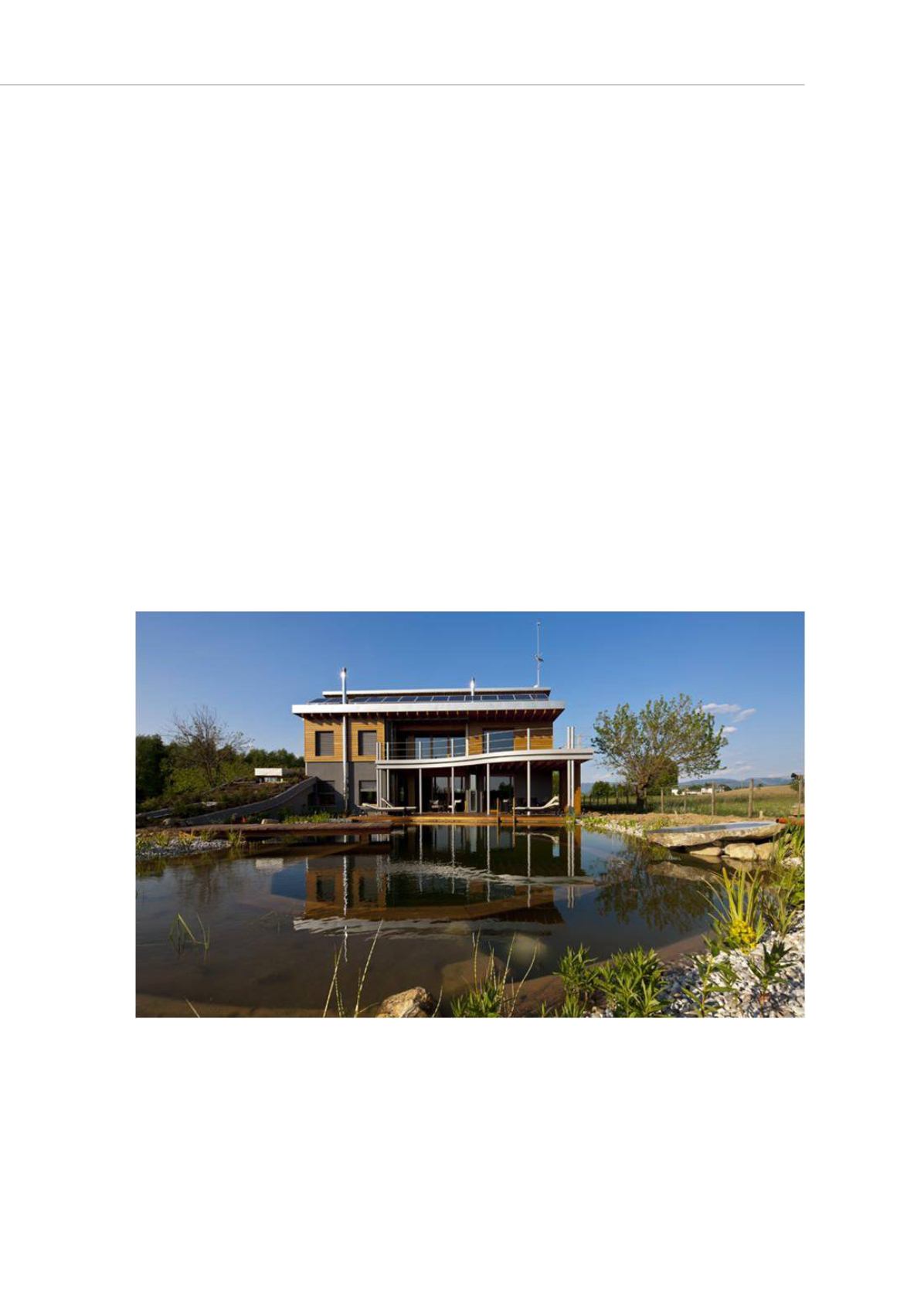
for two years. The second case study was a new building, CasaZeroEnergy in Felettano
(UD, Italy) concluded in 2010 and currently under monitoring.
Following, the validation of the model performed on CasaZeroEnergy will be explained.
This methodology was divided into several steps:
1.
analysis of the local climate,
2.
analysis of the main building features,
3.
decision on which monitored data are important for the analysis and validation of
thermal behavior prediction,
4.
analysis of the energetic behavior of the real building through chosen monitored
data,
5.
building model construction,
6.
dynamic energy simulation,
7.
comparison of energy simulation results and monitored values.
CasaZeroEnergy
One of the test cases used to verify and validate thermodynamic performance analysis is
a northern Italian ZEB, known as
“CasaZeroEnergy”
. The building is a detached house,
finished in 2010 and located in the hills of Felettano (UD, Italy) (Fig.1).
Figure 1: View of “CasaZeroEnergy” in Felettano, Udine – Italy
This smart green building was designed according to the principles of the bio-climatic
architecture, so local climate conditions were checked before the beginning of the design
phase.


