E n e r g y R e c o v e r y o f ‘ 7 0 e s I n d u s t r i a l i z e d B u i l d i n g
517
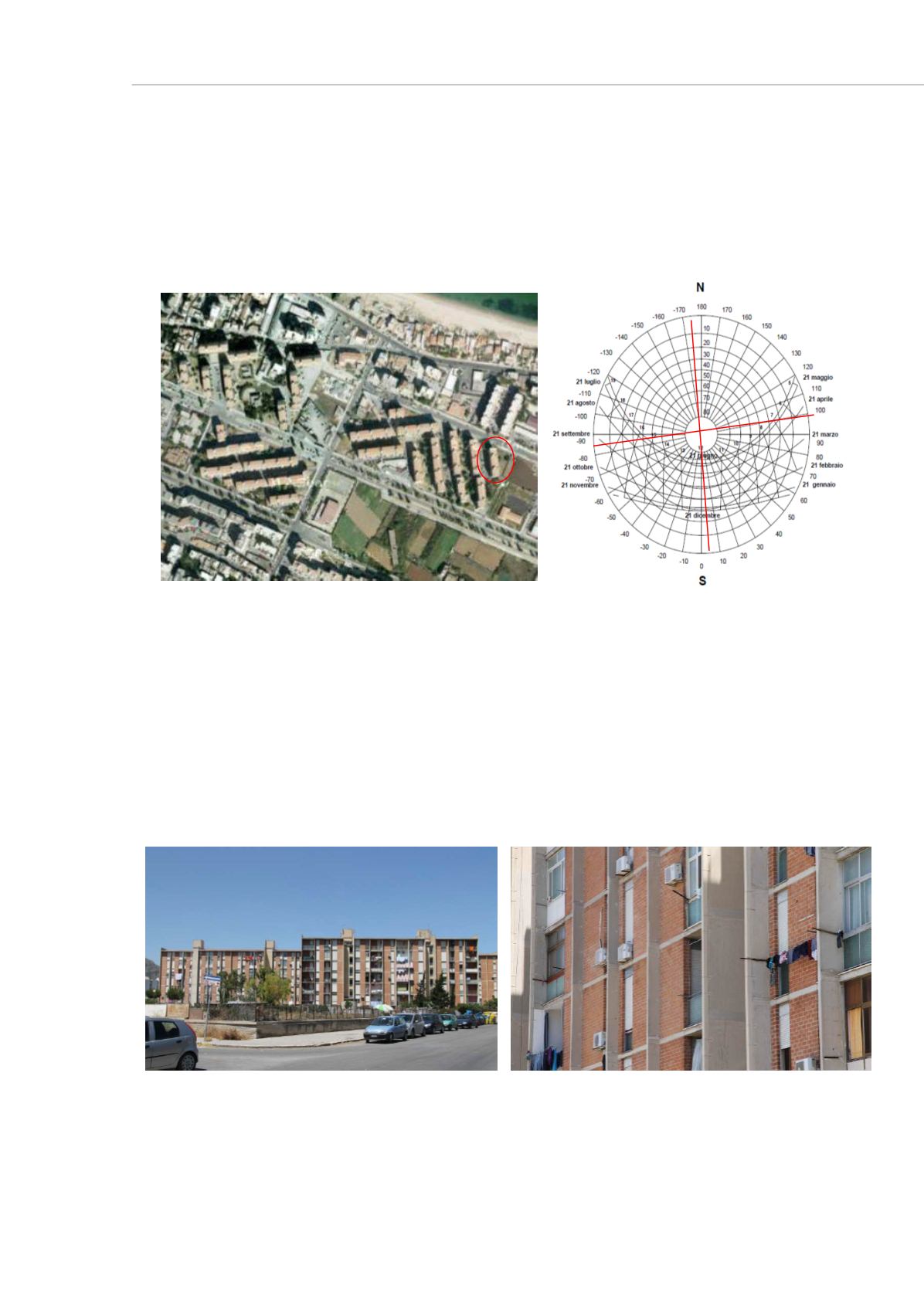
Using the sun path charts (Fig.2), it is clear how the facades to north-east are irradiated
throughout the morning by 6 a.m. until to almost 12 a.m. during all the year. The facades
to south-west are irradiated by 12 a.m. onwards. The facades to north-west are
subjected to solar radiation by 15:00 – 16:00 to 19:00 only in summer (May, June, July
and August) and never by September to March.
The facades to south-east are sunny all the year and almost all the day (until to 15:00 in
July, until 16:00 in August and until to 17:00 in September).
Figure 2: Aerial photo of the buildings under study and the related sun path chart
The adopted construction methods were non-negligible in the energy analysis of these
buildings. These buildings were realized with reinforced concrete load-bearing walls, at
interaxis of 4.64 and 3.74 m, 14 cm thickness, with a 2 cm polystyrene panel glued in the
inside face, and finished with plasterboard, joined to reinforced concrete slabs, 16 cm
thickness, finished to fair faced.
The transverse facades, heading the buildings, were then r.c. walls with no openings.
The longitudinal facades were predominantly made with fair faced hollow brick walls in
the outer face (12 cm), hollow bricks in the inside face (8 cm) and a 10 cm air space,
finished internally with gypsum plaster (Figg.3, 4).
Figure 3: Views of the longitudinal facades


