E n e r g y R e c o v e r y o f ‘ 7 0 e s I n d u s t r i a l i z e d B u i l d i n g
525
Conclusions
By the analysis done, it was possible to assess how industrialized methods buildings in
the '70s show a strong deficit in thermal performance resulting in high energy
consumption. Being a huge building stock, the intervention would have a considerable
overall energy saving.
In particular, by the study conducted, it was found that interventions not particularly
expensive on the elements constituting the envelope (outer walls, windows, open spaces
floors or floors on inhabited rooms and roofs), responsible of high heat dispersion, would
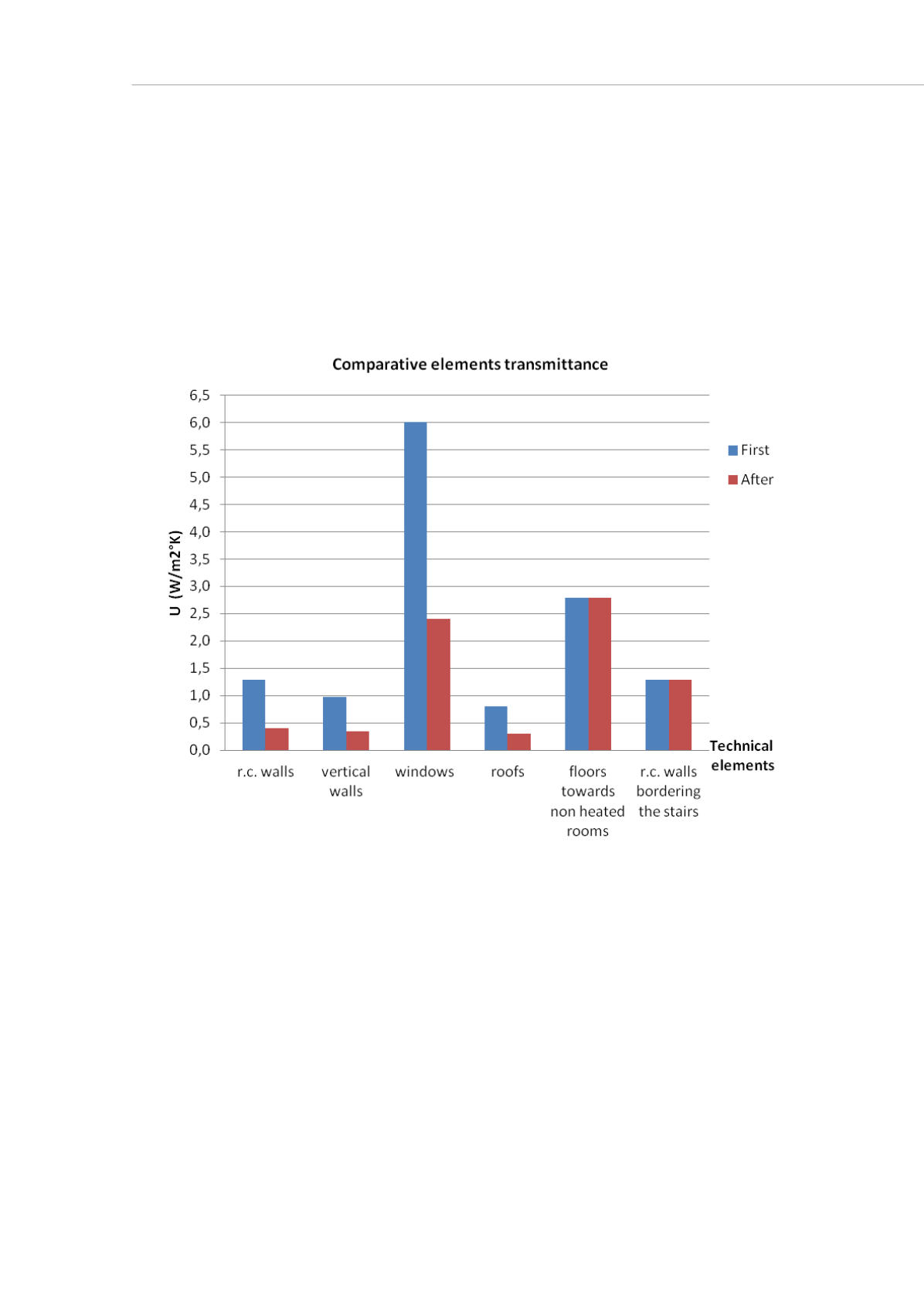
improve thermal transmittance of about 68% for r.c. walls, 64% for external walls, 62%
for roofs and 60% for the casings (Fig.9).
Figure 9: Transmittance of the elements of the envelope before and after interventions
Also by performing the calculation of thermal power dispersed only by conduction,
neglecting losses by convection (ventilation) and by radiation as negligible, on the case
study, it was found that, with the intervention plan, it is possible to obtain a reduction of
the dispersed thermal power of about 50%. Due to the low cost and feasibility of
proposed technical solutions, these ones can be applied, taking into account the several
environmental parameters for buildings constructed with the same technology in other
local, national and international, obtaining significant energy savings both in winter and
in summer. Significant aspect in the choice of measures proposed is the non-
invasiveness, the respect of architectural features and the improvement of environmental
quality. It is possible to state that with proper precautions, it is possible to apply
sustainable interventions on the existing housing.


