Z E M C H 2 0 1 2 I n t e r n a t i o n a l C o n f e r e n c e
522
The grid has been designed and dimensioned as to create a green wall having 10 cm
thickness. Being such a system put on the outside of the building, it is a removable
intervention at any time.
These green walls improve the energy performance of r.c. walls which are juxtaposed
thanks to the polystyrene sheets between the vegetation and the wall. Furthermore,
these ones reduce the energy dispersions of the building, partly reflected and partly
absorbed by the leaves. Finally, in the case of dense vegetation, the air movements on
the wall may also dim, generally contributing to increase the heat dispersion by
convection. By the analysis of the existing literature, it is evident that thanks to
vegetation, it is possible to obtain an additional resistance of about 0.2-0.3 km
2
/W
depending on thickness and type of vegetation (the improvement in thermal insulation of
the wall reaches about 38%).
Such a system, protecting r.c. walls by solar radiation, thanks to the vegetation, while
avoiding overheating, is much more effective in summer than in winter, since it
determines a temperature reduction of the wall and a time shift of the maximum
temperature for all the walls. The best performance is given by the walls facing east and
west as these ones are more subject to direct solar heat loads. While in winter the green
wall obstructs the possible contribution of solar energy due to solar radiation. Then the
system is definitely energetically advantageous even in winter for the wall facing north,
not exposed to direct solar radiation (if an evergreen is there). While for the walls
exposed to east, west and south, there is an energy improvement only in the case in
which the reduction of heat loss is higher than the contribution of energy due to solar
radiation.
These green walls, beyond ensuring surface temperature control of the external walls
and thus enhancing the thermal comfort conditions, also contribute to the reduction of
noise pollution and clean air by filtering dust and gases.
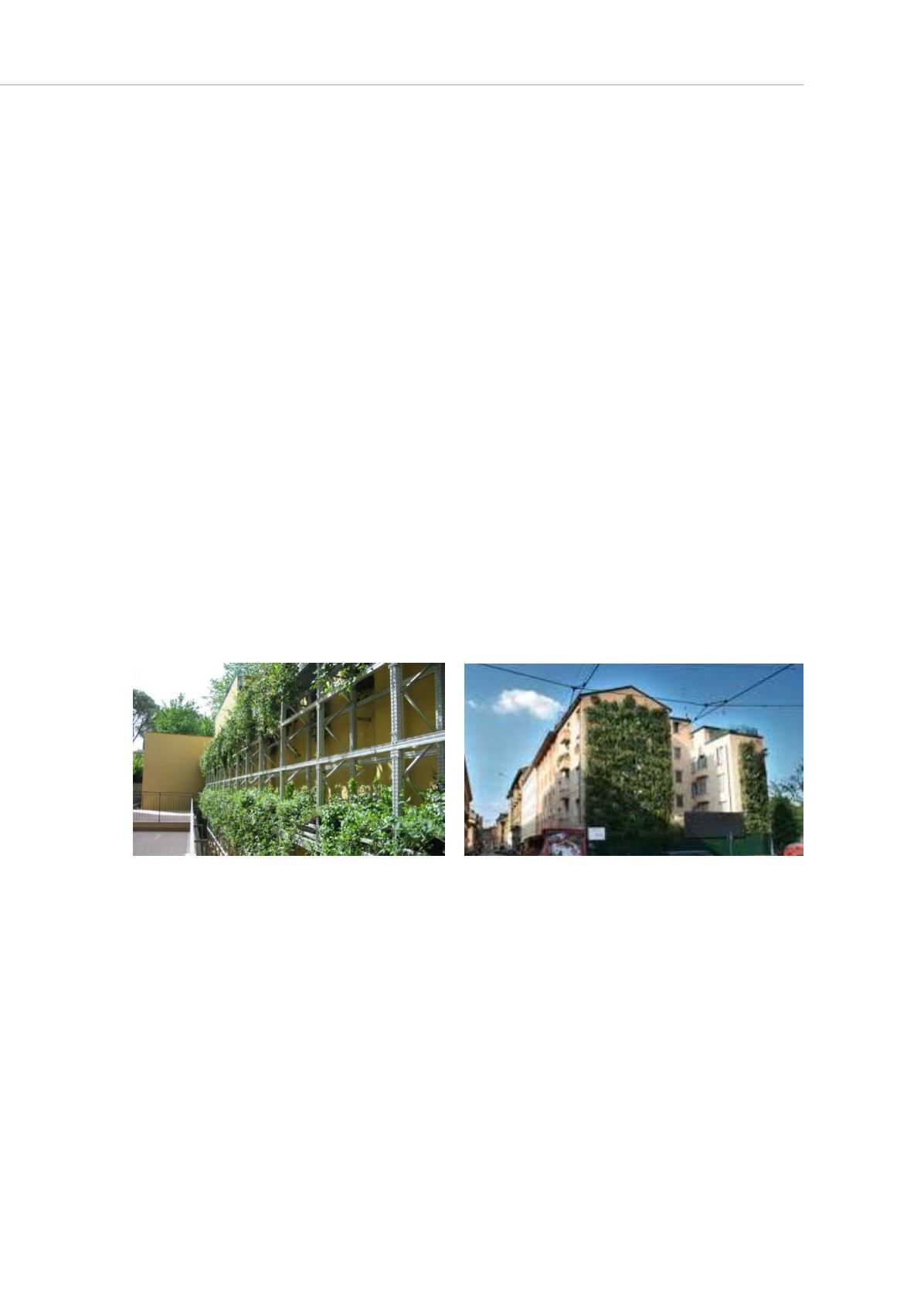
Figure 7: Example of structur for green wall and an green wall realized in a building in Milan (Italy)
While for the longitudinal facades, the intervention consists in the addition to the
functional layers of the outer walls, into the existing air space of the wall, of an insulating
loose material able to decrease the transmittance values below the minimum of the
current legislation (U=0.351<0.41 W/m
2
K).
This type of intervention really simple and usual for new constructions begins to be
applied also in case of interventions on the existing housing stock. It consists in the
insufflation
inside the air space of granules of expanded perlite through holes in the
outer surface of the wall, next to the superior r.c. slab. Making a single hole 8 cm
diameter in the middle part of the wall, it is possible to fill an area of about 12-15 square
meters, corresponding to the walls of the analysed buildings.
This type of intervention, even possible by the outside of the building, does not modify
the activities of the users, but may eventually need a crane or an aerial platform.


