Z E M C H 2 0 1 2 I n t e r n a t i o n a l C o n f e r e n c e
532
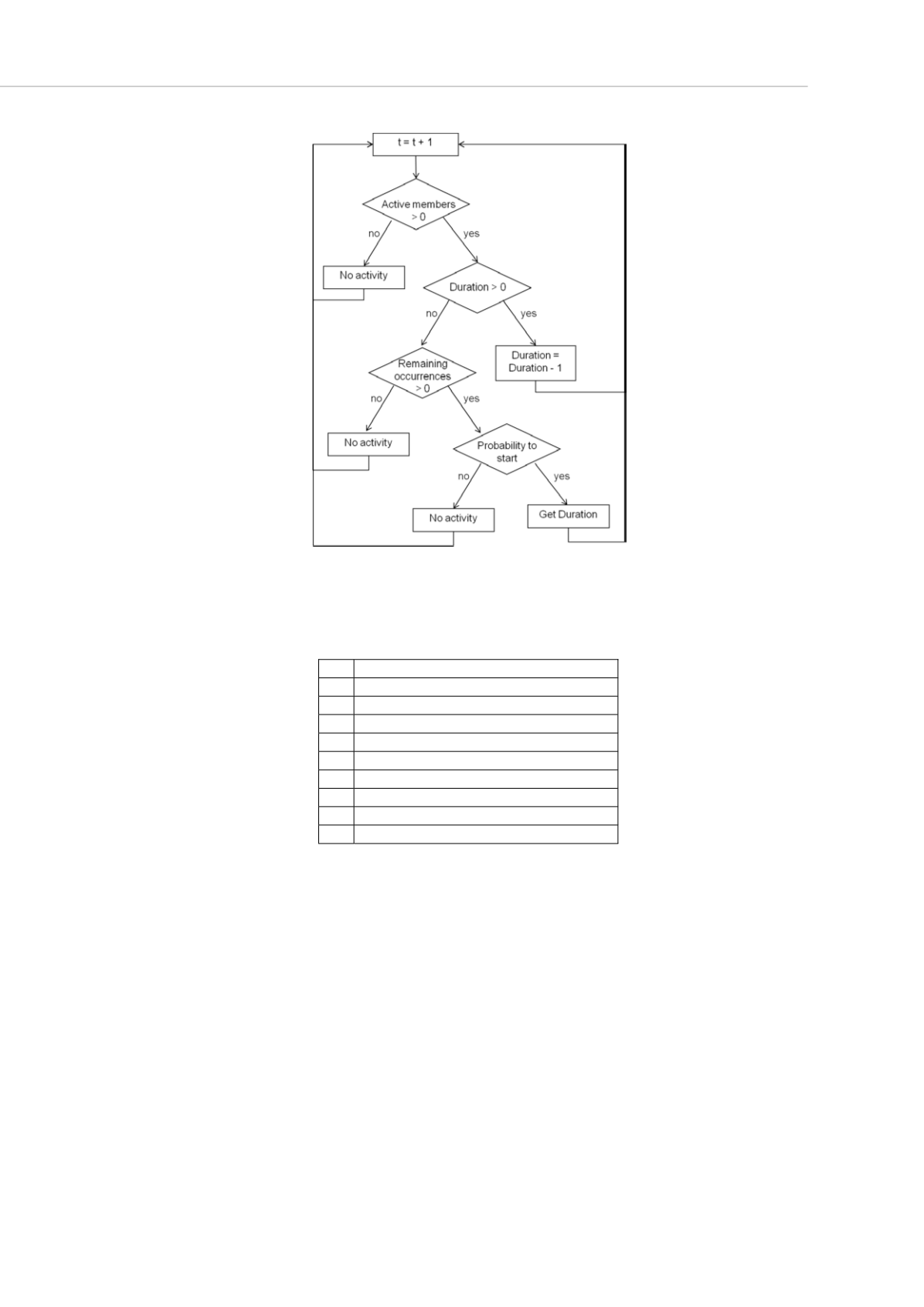
figure 3: Flowchart activity model
table 2: Included activities
Activities
1
Using a computer
2
Preparing food
3
Cleaning
4
Ironing
5
Watching TV
6
Listening to music
7
Doing the dishes
8
Washing or drying clothes
9
Taking a bath or shower
On the household level, an independent chain is modelled for each activity based on a
number of conditions. A prerequisite for any activity to occur in the household is the
presence of at least one active household member. Whenever the previous condition is
met, the probability that a certain activity occurs in the household is calculated. In the
TUS database, primary and secondary activities are included to account for multitasking.
Following the same philosophy, no restrictions are imposed in the model to limit the
number of activities going on simultaneously. One of the main risks of the model is the
excessive reoccurrence of activities on the same day. For example, after the activity
‘preparing food’ has ended, the algorithm will restart computing the probability that the
activity starts and possibly restarting the activity a few time steps later. To deal with the
issue, a maximum number of occurrences are assigned to a household, which is
dependent on the activity and the time. As shown in
each day is divided in four
time blocks, to which an occurrence probability distribution is assigned for every activity.
The distribution was derived from the TUS data.


