I n d i v i d u a l H o u s e h o l d B e h a v i o u r M o d e l l i n g
533
figure 4: Maximum occurrence as a function of the time block
In
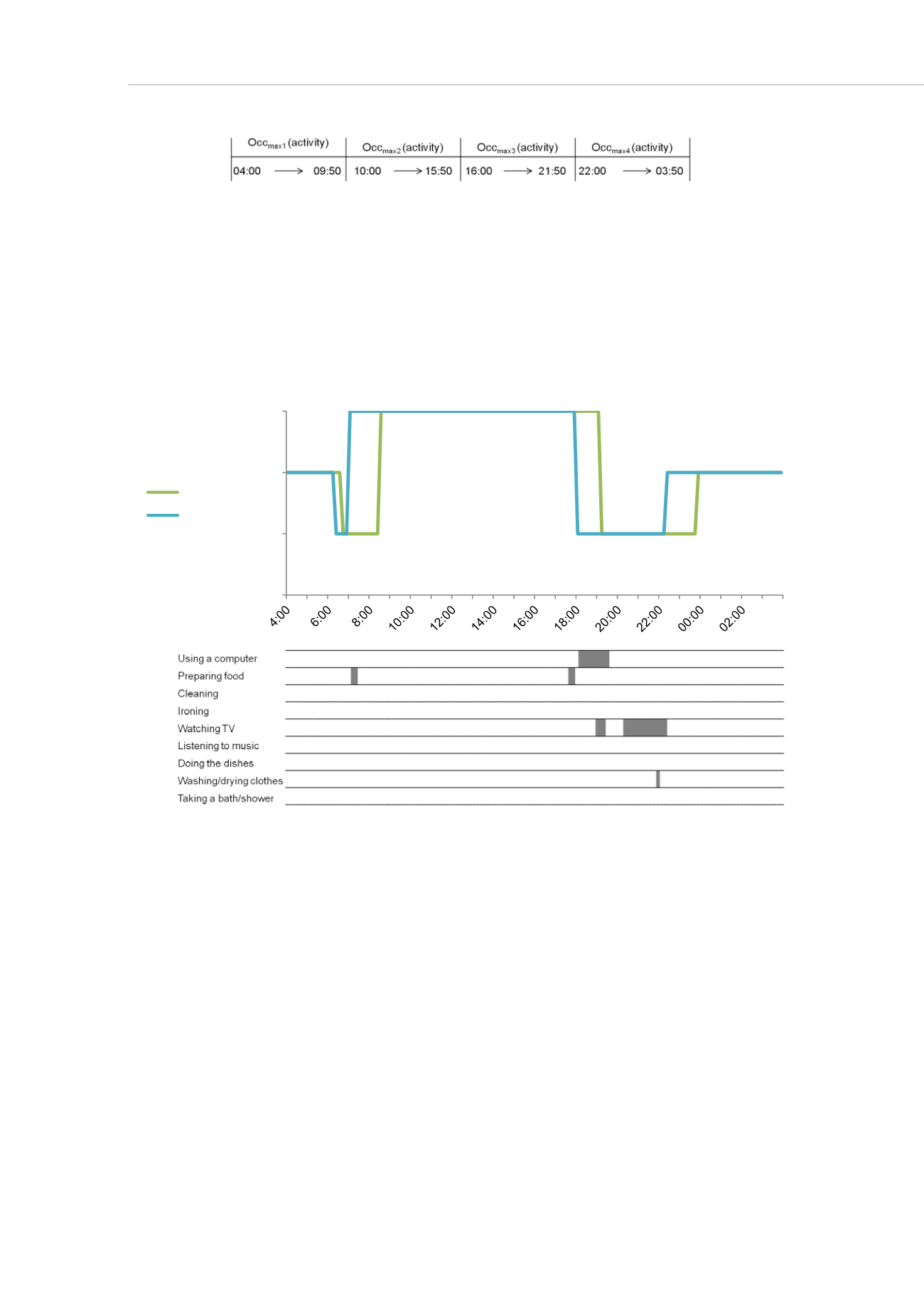
example output of the occupancy- and activity model is shown. In
the occupancy pattern is visualized for the two household members. We can see that
both members get up in the morning, spend some time at home before leaving the
house for a substantial time, return to the house in the evening and go back to sleep a
few hours later. In
the energy-demanding activities are shown. As expected,
food is prepared in the morning and in the early evening. After dinner, the computer and
TV are being used, partly simultaneously. Before going to bed, a washing machine is
filled.
figure 5: Example output for a two-person household showing (a) the
occupancy profile and (b) the activity profile for a weekday
Furthermore, seasonal effects on occupancy and activity behaviour are studied. Note
that for the analysis the whole dataset is used instead of selections of household types in
order to avoid data scarcity. In
the average occupancy of the population is
shown as a function of the seasons. The area under the lower curve represents the
fraction of people who are present and awake at a certain time; the area between the
lower and the upper curve shows us the fraction of people who are asleep; the area
above the upper curve illustrates the group of people who are absent. The largest
deviations can be noticed during summertime, when people appear to spend more time
away from home. In
the seasonal effects on four activities are shown. It is clear
that some activities are more sensitive to seasonal influences than others. On the one
hand, basic activities such as preparing food or doing the dishes hardly show any
variation. On the other hand, leisure activities such as watching TV or using the
computer appear less frequently in summer time in comparison to the other seasons. We
may conclude that some seasonal effects can be observed, especially in summertime.
Nevertheless, we decided not to incorporate time of year as a variable in our occupancy
0
1
2
3
Occupancy State
Member 1
Member 2
Occupancy states:
1 present and awake
2 present and sleeping
3 absent
(b)


