Z E M C H 2 0 1 2 I n t e r n a t i o n a l C o n f e r e n c e
536
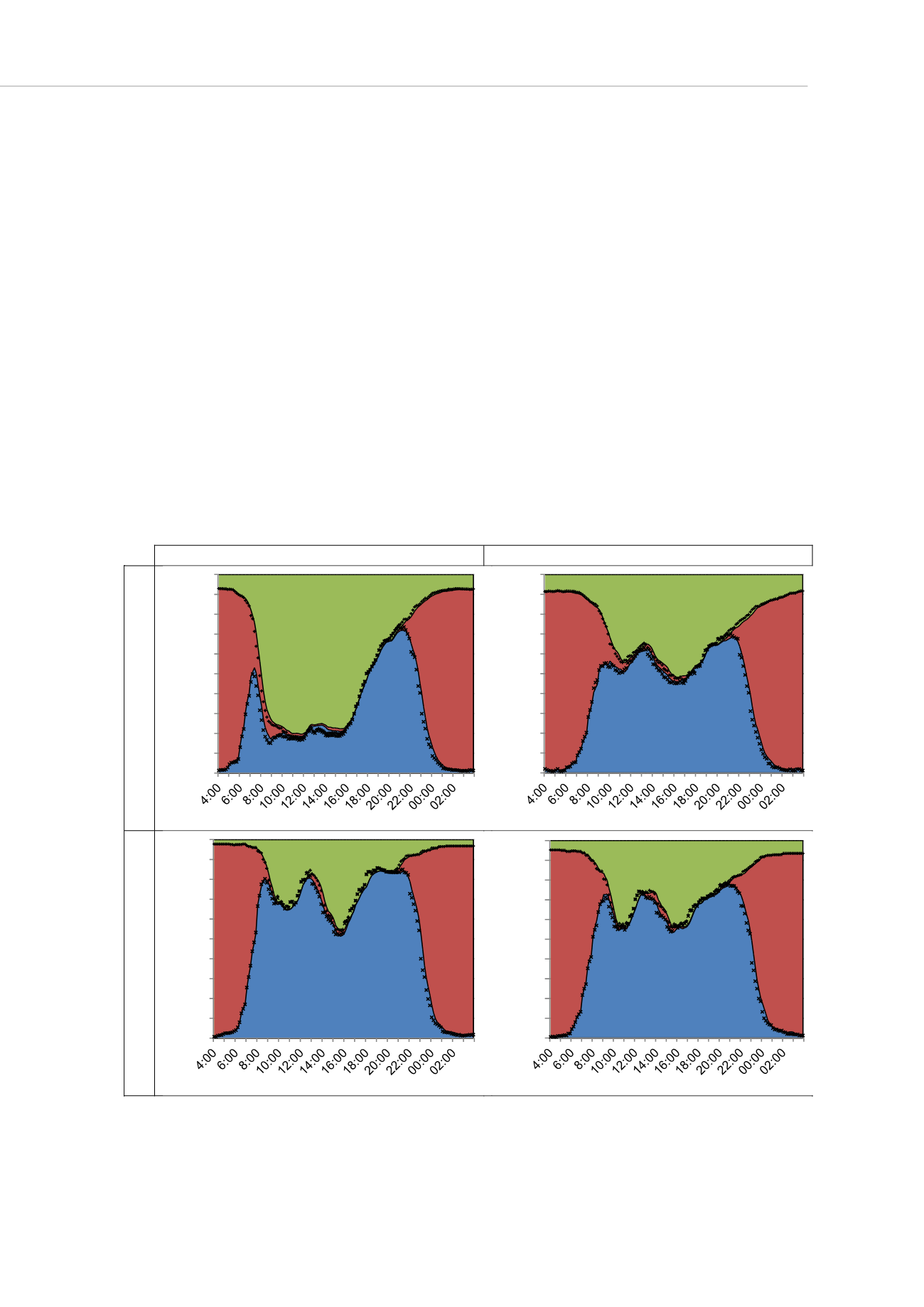
A comparison between different household types and between days is provided in
On the one hand, we can compare weekday and weekend day behaviour for
the average couple with children where both adults work full time. On weekdays, we can
clearly observe a work rhythm where the household members get up between 6 AM and
8 AM, leave the house and return home between 4 PM and 10 PM. Different patterns
can be observed on weekend days, when people get up later and spend more time at
home. The curve of people leaving the house shows two peaks, one before noon and
one in the afternoon, the latter being larger. The group of people staying at home in the
evening more or less remains the same, although more people appear to be away from
home instead of asleep in comparison to an evening on a weekday. On the other hand,
the occupancy patterns of elderly couples show less variation between weekdays and
weekend days as opposed to working couples with children. We can observe that during
week days, more people tend to leave the house during the afternoon, whilst during the
weekend they return home later in the evening. Few variations are found in the hours
elderly people wake up or go to sleep.
When comparing both household types to each other, the largest differences obviously
occur on weekdays, when working couples spend more time away from home. During
the weekend, the differences are smaller, although fewer elderly are expected to be
asleep after 8 AM. Also, they are slightly less likely to leave the house in the afternoon.
Weekdays
Weekend days
Couple (2x full time) + children
Couple (elderly)
fi
gure 9: A comparison between different household types and day types
0
0.1
0.2
0.3
0.4
0.5
0.6
0.7
0.8
0.9
1
Degree of Occupancy (-)
Time (h)
0
0.1
0.2
0.3
0.4
0.5
0.6
0.7
0.8
0.9
1
Degree of Occupancy (-)
Time (h)
0
0.1
0.2
0.3
0.4
0.5
0.6
0.7
0.8
0.9
1
Degree of Occupancy (-)
Time (h)
0
0.1
0.2
0.3
0.4
0.5
0.6
0.7
0.8
0.9
1
Degree of Occupancy (-)
Time (h)


