P r e – E x i s t e n c e s a n d E n v i r o n m e n t a l S u s t a i n a b i l i t y
561
electric engine and its maintenance.
Sidewides, on the contiguous low body construction, are situated the workshops and the
storehouse for the materials. These two buildings will host the scientific and
technological center, keeping unchanged theirs planimetric structure, that intrinsically, as
testimony of the industrial architecture, represents an element of cultural value.
In the passenger outbuilding, that in spite of recent recovery interventions has currently a
lot of unemployed spaces, the old abandoned cafeteria will be proposed again in the low
ground, alongside of the entrance hall and in the upper stories – originally designed for
the leader managers accommodation – will be placed the management offices of the
whole complex (station and scientific center).
Examining the station plans tracked, placeable over a period of time stretching from the
early decades if the 1900 to 1953, can be shown that, unlike the buildings made in the
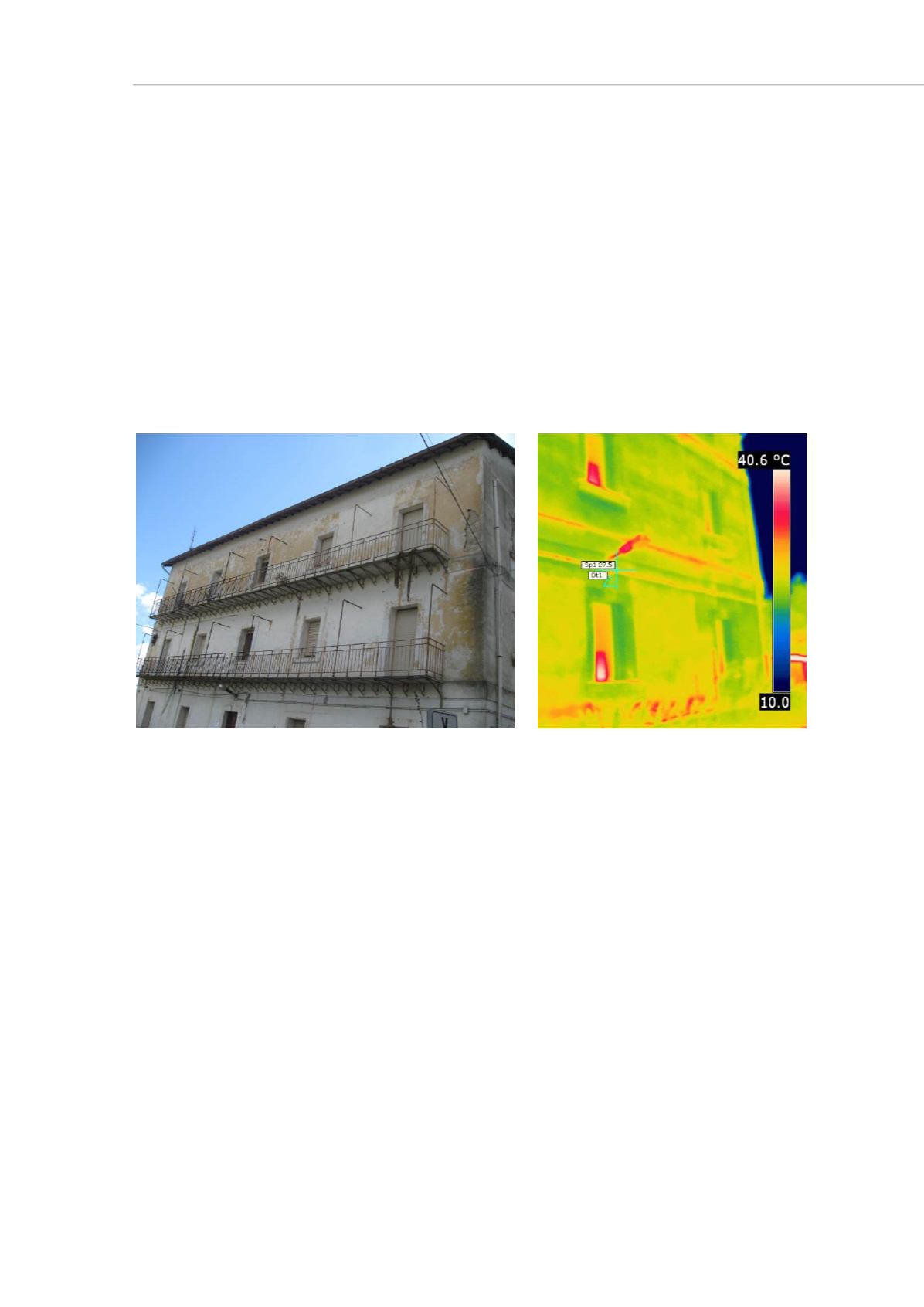
service of the rail track, the dorms (fig. 7) arranged along the station road maintained
their original planimetric set-up with the exception of negligible volumes made for plants.
These buildings are all constituted by squared or cantonal ashlars as bearing masonry,
made up with solid bricks whose thickness is around 60 cm. The blocks are of sandstone
(arenaria), commonly used in Sicily and having good characteristics of thermal inertia for
the Mediterranean climate, a coefficient of thermal wave phase shift of about 11h and an
attenuation factor of 0,12.
The floor are made of iron and hollow tiles, but it was not possible so far to detect if in
place of the reinforcing “I” bars have been used vignole tracks, as customary for the
railway buildings of that era (using “rotaje vignole” was specifically suggested by the
Technical Departments of Sicilian Railway, as showen by the notations listed on the
boards provided at the Royal Corp of Civil Engineers). In roof we can find typical solution
usually realized in third and second class buildings: hip-roof closures, made with simple
framework of wooden beams, partition and surface of Marseilles tiles. All the buildings
are characterized by an inaccessible attic, isolating the pitched roofing creating an
interspace (over a meter).
Focusing on residential buildings are detectable two possible types: mini-apartments and
a hotel. The building for the first type spreads over three floors above ground and is able
to meet the demand of 30 students (fig. 8), divided into 5 unit per apartment; instead, the
block intended as hotel could accommodate 6 students/foreigners by floor - considering
two doubles and two single rooms on each level - to the amount of 18 sleeping
accommodations.
A first simplified analysis
using the free software “CasaKyoto”, qualitatively conducted on
the accommodation building, taking into account the climatic area, exposure and
Figure 7 : The dorms - frontal view and Thermography of facade showing brick
bands


