Z E M C H 2 0 1 2 I n t e r n a t i o n a l C o n f e r e n c e
562
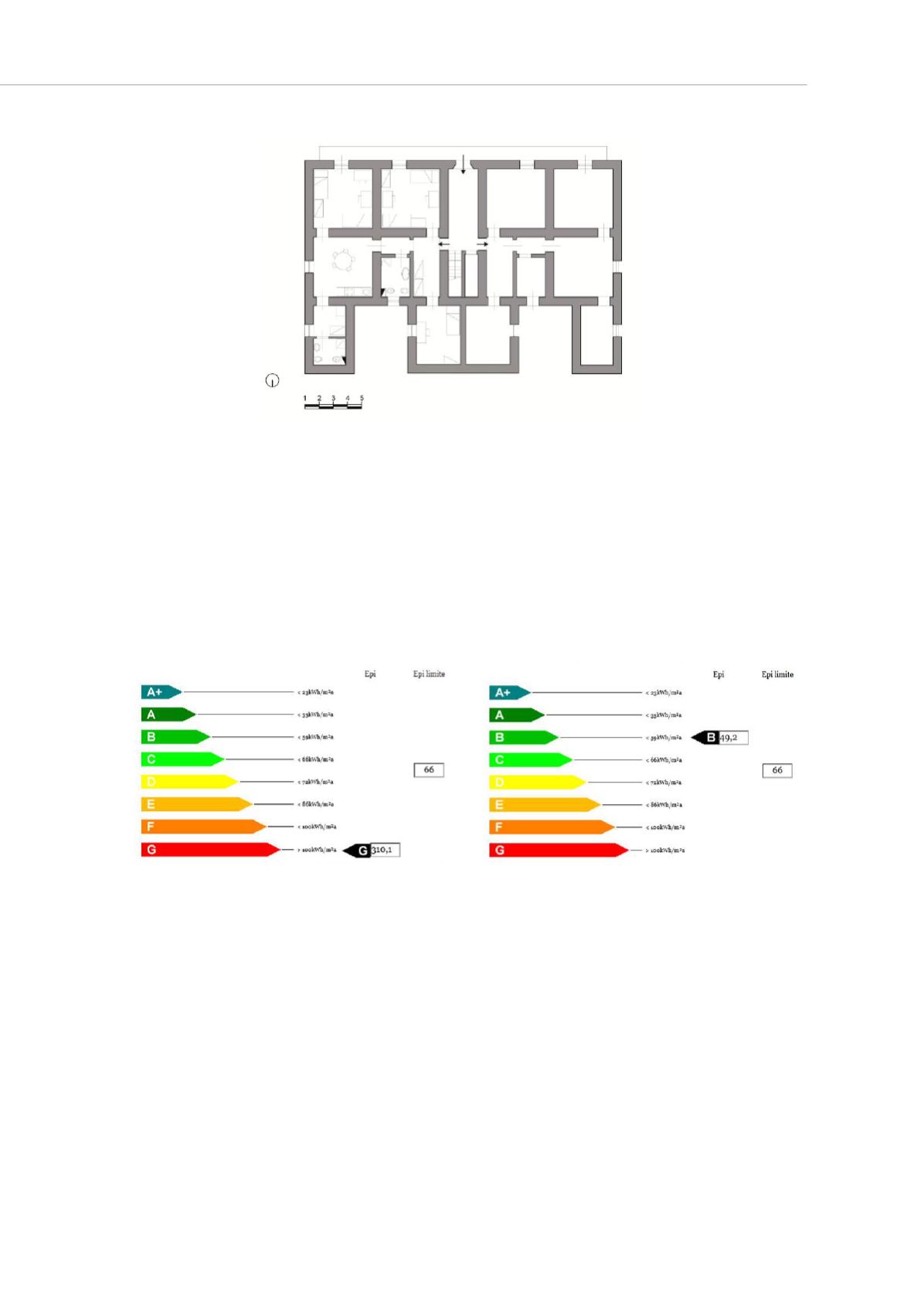
construction type, already shows that margins for improvement are very large in terms of
energy performance (fig. 9).
These improvements were estimated assuming operations of hyper-isolation of the
vertical side walls, the top closures and frames replacement, without going into the
question of possible actions aiming a supply from renewable sources, which are well
suited with the nearby facility station (energy recovery through thermal exchangers, wind
energy generated during the passage of trains
).
To identify improvements after intervention the parameter of transmittance of the
technical elements is assumed, so the resulting values are compared to the limits
imposed by current regulations (U
adm
) for the climate zone E. Because of the extent of
the complex the results of the simulation interest only the building of mini-apartments,
this structure was chosen as significant example and materials used to simulate the
hyper-isolating intervention are always transpiring.
The results of the simulation conducted on the mini-accommodation building that
presents building typology homologous to the other construction designed for the
residence and their exclusive services are reported below. For evaluating the
transmittance of the walls (tab.1) the conductivities of the different functional layer that
compose the masonry have been identified; in particular for the structure – as it wasn’t
possible to make inquires - values have been extrapolated tables, putting ourselves in
precautionary measures in a intermediate case. The classes that can be estimated in
respect to the masonry structure are three: arenaria (λ =1,30-1,75), calcareous compact
stone (λ=0,70) and in the end calcareous granular stone (λ=0,95).
Figure 8 : Scheme for the mini-accomodation buildig (30 student estimated)
Figure 9 : The so called "energy tag" valuated before and after hyper-isolation
intervention


