Z E M C H 2 0 1 2 I n t e r n a t i o n a l C o n f e r e n c e
190
SBEM is provided by the UK government and can be accessed either through iSBEM
or via approved software packages which
provide a more user friendly interface to SBEM
Passive House Planning Package (PHPP)
PHPP has been developed by the PassivHaus Institute in order to support the
PassivHaus Standard and the system of independent certification promoted by the
PassivHaus Institute, founded in 1996 in Darmstadt, Germany. (Reason & Clarke 2008).
More recently the Passivhaus Trust has been established in the UK with a wide range of
partners and collaborators:
PHPP can be used for
any building type “haus” having a wider meaning in German than purely domestic. PHPP
is an Excel file with 34 work sheets.
Not all the spread sheets require data inputs as many are intermediate calculation steps.
The spread sheets require fabric values, shading and ventilation in order to calculate
heating and cooling loads. It then calculates hot water demand and solar input, followed
by electricity used by appliances including lighting and auxiliary equipment. These are
brought together in a Primary Energy Value (PE Value) following which system types
and efficiencies are entered. Climate data is factored in along with internal and solar
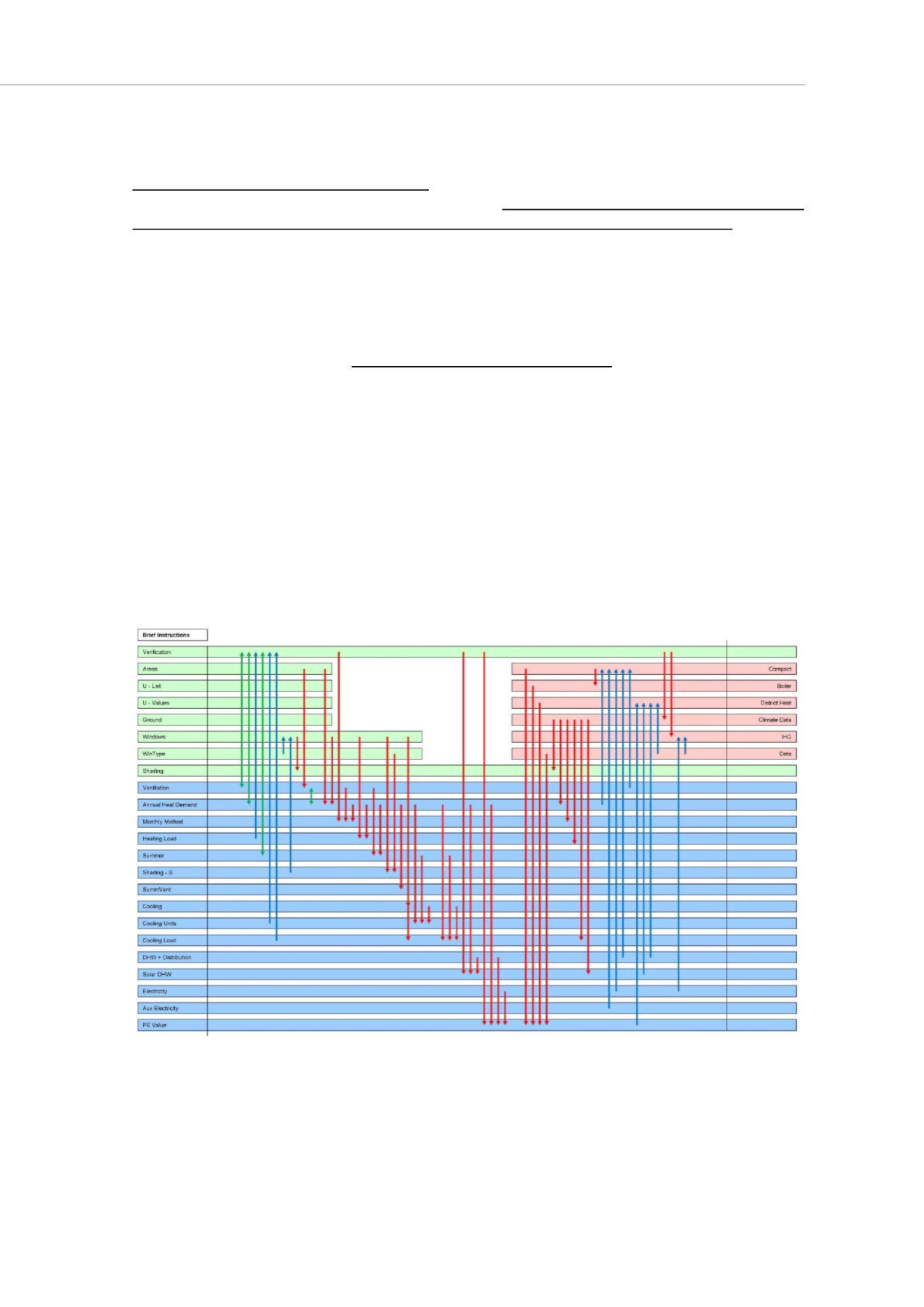
heat gains. Figure 2 gives an indication of the inter-relationships between the work
sheets that are visible in demo mode however it seems likely that there are additional
links through calculation steps and hidden sections which are not immediately visible.
Figure 2: Links Between PHPP Spread Sheets
Comparisons
The 3 calculation methodologies differ in what energy usage is included, the algorithms
used to calculate the energy use and the assumptions made with regard to occupancy,
appliance use etc. In the first instance, we compare the inclusions and assumptions


