Z E M C H 2 0 1 2 I n t e r n a t i o n a l C o n f e r e n c e
332
could lead to 6 million extra tonnes of CO
2
emissions per year by 2020 (Carbon Trust
2005). Therefore, it is important to predict the energy demand for heating and cooling
due to climate change adaptation.
It is expected that the use of air conditioning system will become popular in dwellings if
warming climate is experienced in the UK due to Global Warming. On one hand, cooling
systems become common-place which is likely to significantly increase the UK electricity
consumption caused by dwellings. On the other hand, warming climate could reduce
heating demand for winter seasons and therefore reduce the demand for natural gas.
The paper examines the likely impact on heating and cooling energy consumption, and
carbon emissions from heating and cooling systems in existing dwellings under the IPCC
TAR A2 climate change scenario, considering years 2020s, 2050s and 2080s.
Furthermore, it considers whether the reduction in heating demand can offset the
increase in carbon emissions from cooling systems, and the effect on the energy
consumption considering three different insulation levels and two construction methods.
Energy Efficiency of UK Housing
Energy usage in the domestic sector accounts for around 30% of the total UK energy
consumption, which has risen by 23% over the last 35 years. Carbon emissions from the
domestic sector have been reduced however are still 38 million tonnes of carbon per
year is emitted to the atmosphere. Carbon emissions have been reduced partly due to
the change in fuel type for space heating rather than an actual decrease in the total
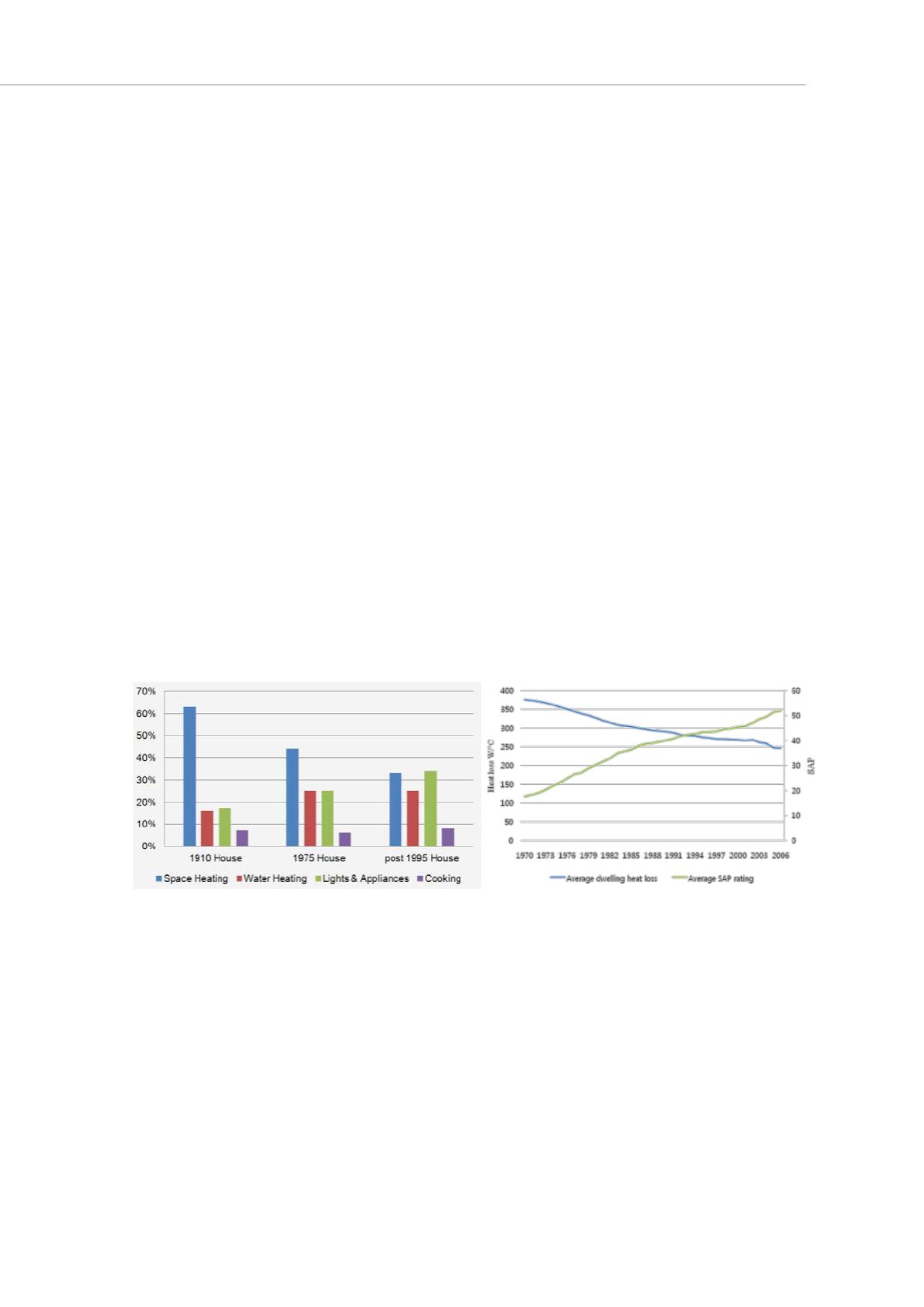
energy consumption. Space heating and domestic hot water heating use is still over half
of the energy use in UK homes. As the central heating systems are increasing rapidly,
there is an expectation of higher internal air temperatures. Over the same period, the
percentages of energy used by lighting and appliances have more than doubled (see
Figure 1a). The rise has been offset to some degree by better insulation of the building
fabric and higher efficiency of the heating appliances.
a) Consumption of energy distribution by age and
end-use in UK dwellings.
b) Change in heat loss in an average dwelling and
SAP score.
Figure 1. Energy Efficiency of UK Housing.
Increasing building energy efficiency is the basic principle and method which is adapted
by the UK government to reduce energy consumption and carbon dioxide emissions
from the domestic sector, and increasing thermal comfort in UK homes. The
Warm Front
is a major government funded energy efficiency scheme in England and the scheme
mainly aimed to reduce fuel poverty by providing grants for the installation of cavity wall
insulation, loft insulation, draught proofing and the option of improving existing gas
central heating system (Directgov
). Since the government funding for
energy efficiency schemes introduced, a considerable progress has been made with the
cavity wall and loft insulations. In 1974, 2.4% of cavity walled houses had cavity wall
insulation. By 2006, this had risen to 39.3%. In 2006, 57.3% of loft had 100mm or more
of insulation and 20.5% had 150mm or more insulation. In 2008, 92% of homes had


