Z E M C H 2 0 1 2 I n t e r n a t i o n a l C o n f e r e n c e
322
as the slats are assumed to be purely diffusers. In what respects diffuse solar radiation,
only diffuse-to-diffuse properties are determined. Therefore, for solar wavelengths direct-
to-direct, direct-to-diffuse and diffuse-to-diffuse optical properties should be calculated.
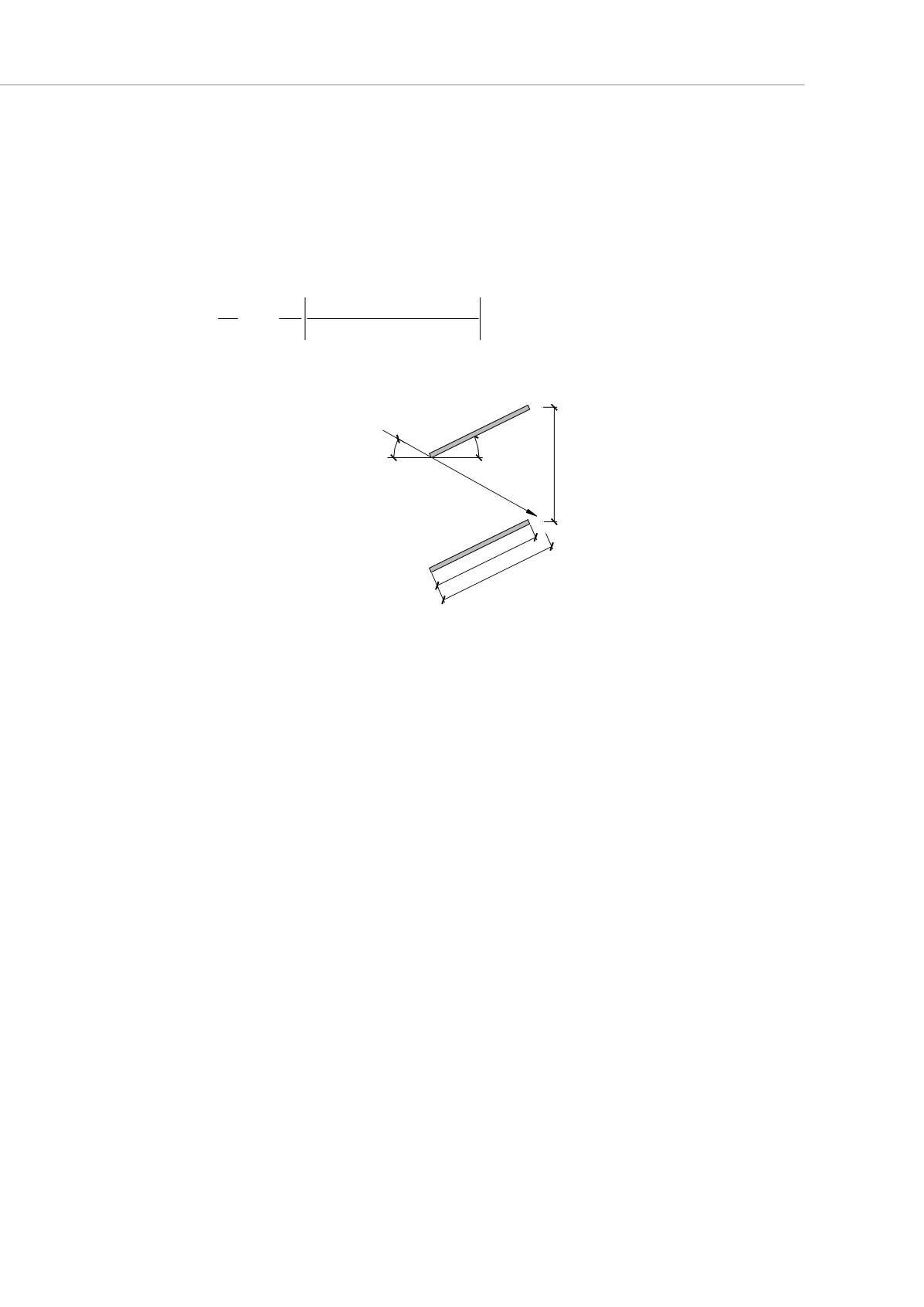
Direct-to-direct (DD) transmittance is defined as the fraction of direct solar radiation
passing directly through the blind assembly without hitting the slats, and is purely a
geometric problem. It can be obtained from equation 1 (see Fig. 3):
φ
φ
ψ
φ
ψ
τ
cos
sin
cos
cos
sin
D
L
1
m
L
1
b
b
b
DD
f,
blind
+
−= −=
(1)
where
L
b
is the slat width,
D
b
the slat spacing,
m
the portion of slat illuminated by direct
radiation,
ψ
the slat angle and
φ
the profile angle of the incident solar beam radiation.
D
m
L
b
ψ
φ
b
Figure 3: Direct solar radiation passing directly through the blind.
For the back direct-to-direct transmittance, the same expression (Eq. 1) can be applied
but using the symmetrical slat angle value (
ψ
b
=
-
ψ
f
).
The net radiation method is used for solving the radiant energy exchange within a blind
cavity formed by two slats and the inside and outside openings (fictive surfaces) and,
hence, for calculating both direct-to-diffuse and diffuse-to-diffuse solar-optical properties
of venetian blinds . Each slat surface can be discretized into different elements and each
element was assumed to be flat, of negligible thickness, gray, isothermal, uniformly
irradiated, perfect diffuser and with non-temperature dependent properties. In this paper,
only the discretizaton into five equal elements (as indicated in ISO 15099 (2003)) will be
used. The impact of diffferent discretization schemes on solar-optical properties
calculation of venetian blinds can be found in Gomes (2010) and Gomes et al.
(2012).The energy balance on each surface is modelled in terms of radiosity
J
(total flux
of radiant energy leaving a surface) and irradiation
G
(total flux of radiant energy incident
upon a surface). The irradiation at surface
i
can be expressed in terms of the radiosities
of all (
n
) blind cavity surfaces (including the openings) as follows:
∑
=
→
=
n
1j
j
j
i
i
J F G
(2)
where (
j
i
F
→
) is the radiative view factor, which represents the fraction of radiation from
surface
i
that reaches surface
j
, determined entirely from geometrical considerations.
The radiant flux leaving a surface
i
(radiosity
J
i
) can be written as the sum of the radiant
flux emitted by surface
i
(
4
i
i
T
σ
ε
) and the reflected portion of
G
i
, and the transmitted
irradiation from the opposite side of the element (in case of non opaque slats):


