Z E M C H 2 0 1 2 I n t e r n a t i o n a l C o n f e r e n c e
664
strength. Also, the RF-US series with spiral yield strength of 1,430MPa showed an
increase in strength by 84% compared to the RF-P series.
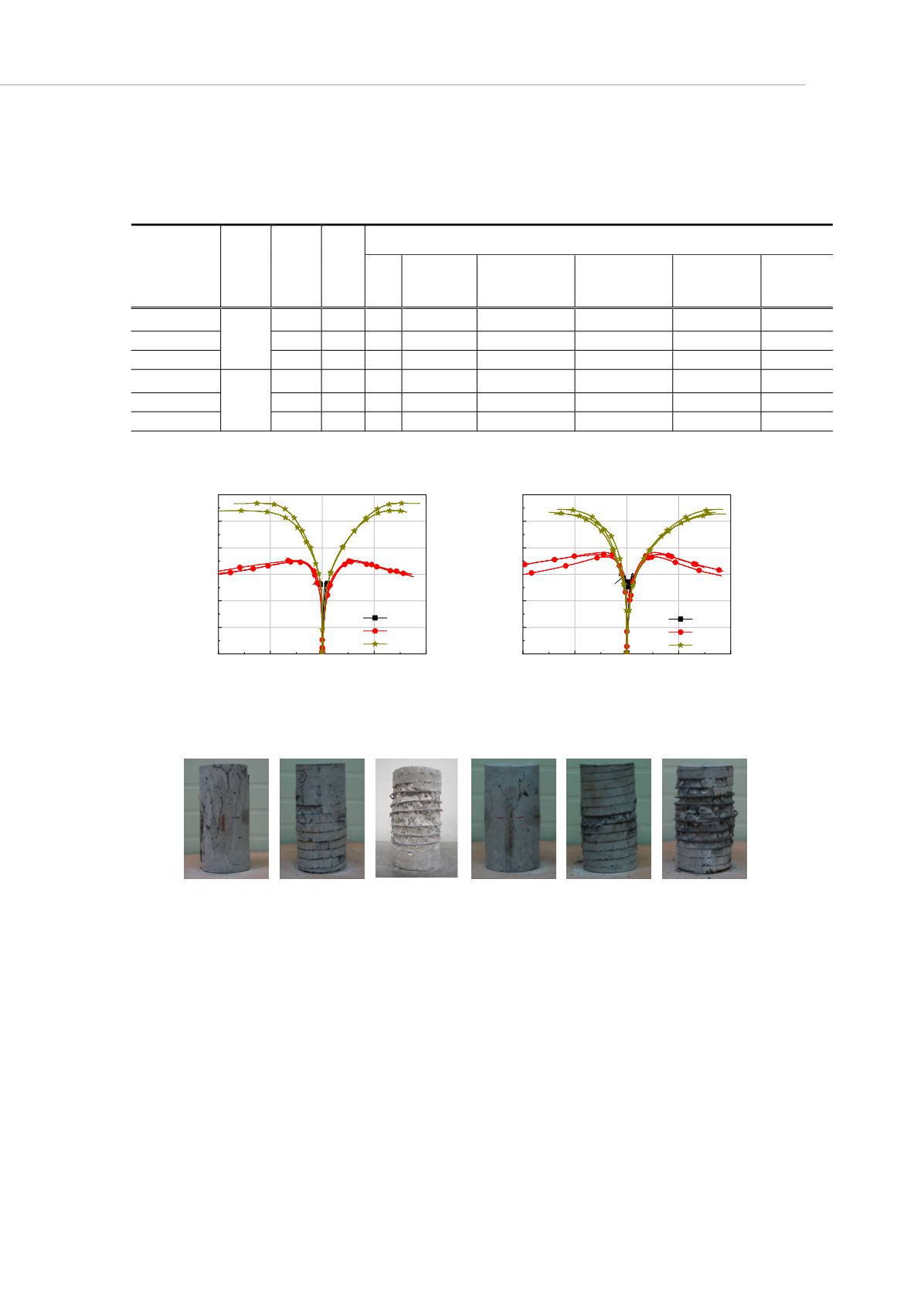
Table 4 Test result
Specimens
co
f
'
(MPa)
wy
f
(MPa)
s
(mm)
Test results
cc
f
'
co
cc
f
f
' / '
Axial strain
at peak load
Spiral strain
at peak load
Axial strain
at yielding
Yielding
of spiral
NA-P
28.0
-
-
-
-
0.0021
0.0013
-
-
NA-NS
472
25 34.8
1.24
0.0118
0.0078
0.0062
pre-peak
NA-US
1430
25 55.3
1.97
0.0284
0.0039
0.0233
pre-peak
RF-P
29.1
-
-
-
-
0.0022
0.0013
-
-
RF-NS
472
25 37.4
1.29
0.011
0.0104
0.0055
pre-peak
RF-US
1430
25 53.6
1.84
0.0351
0.0081
0.0175
pre-peak
0
10
20
30
40
50
60
-0.04 -0.02 0.00 0.02 0.04
NA-P
NA-NS
NA-US
Strain (%)
Stress (MPa)
0
10
20
30
40
50
60
-0.04 -0.02 0.00 0.02 0.04
RF-P
RF-NS
RF-US
Strain (%)
Stress (MPa)
(a) NA series (b) RF series
Fig. 4 Experimental results of specimens
(a) NA-P (b) NA-NS (c) NA-US (d) RF-P (e) RF-NS (f) RF-US
Photo 1 Crack patterns of specimens
The stress-strain relationship for each of each of the specimens measured in the
experiment is shown in Fig. 4. According to the results, the highest stress and ductility
enhancement was observed in the US series regardless of the substitution ratio of the
recycled coarse aggregate.
Failure Modes
The failure modes of the specimens are shown in Photo 1. From the photos, one can
determine that similar failure modes were observed regardless of the substitution ratio of
the recycled coarse aggregate. Maximum strength was reached during the failure of the
concrete in the unconfined area caused by the transverse reinforcement in all specimens.


