C o s t – E f f e c t i v e n e s s M e a s u r e m e n t M o d e l
237
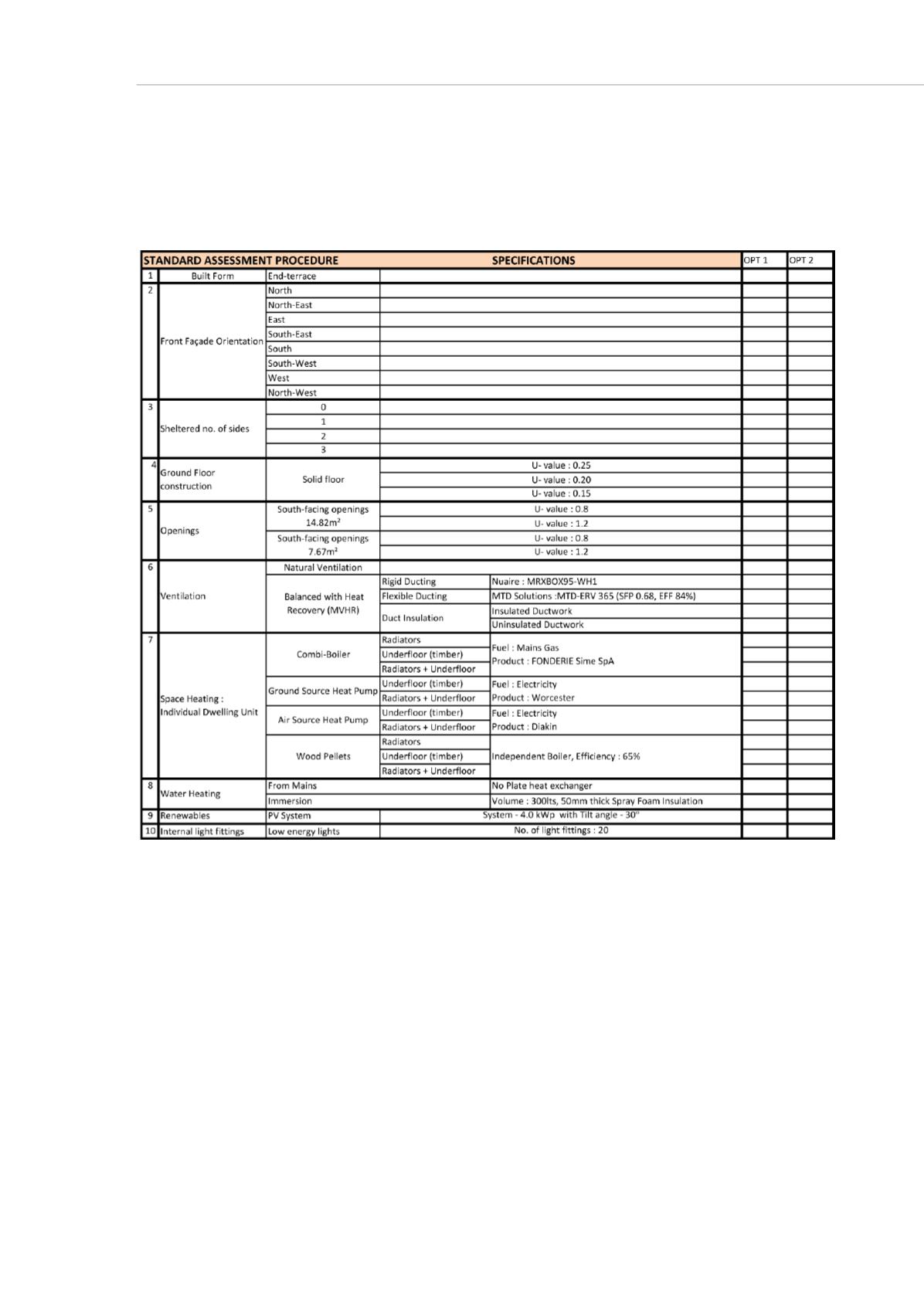
that reflects the current design of ZEMCH 109. Options 2-8 were developed according to
the variations related to the front facade orientation. Moreover, Options 9-11 vary in the
sheltered sides. Options 12-16 concern the variations in terms of the sizes of south
facing window openings accompanied by different U-values. Options 17-34 involves
different types of selected space heating systems, as described above.
Table 1: Selected design parameters for cost-effectiveness analysis
Benchmark Option (OPT 1)
In this study, the current design components and approaches applied to ZEMCH109 is
considered as the benchmark to be compared for the cost-effectiveness measurement of
each option developed. The new house, ZEMCH 109, may have south-east orientation
having three sheltered sides. The ground floor is solid concrete with expected U-value of
0.15Wm
2
K. The area of the triple glazed south facing openings is estimated at 14.82m²
having expected U-value of 0.8Wm
2
K. The dwelling is ventilated using an MVHR system
and heated by an air source heat pump where insulated rigid ducting is considered.
There is no separate water heating. A 4kWp PV system with a tilt of 30
°
on south-east
side will be applied. 20 low energy internal light fittings are installed in the house. Based
on the specifications, as described above, delivered energy, CO
2
emissions, primary
energy and annual operating cost of Option 1 were assessed based on SAP 2009
calculation method (Fig.19). In the results, the negative figures mean that energy and


