Z E M C H 2 0 1 2 I n t e r n a t i o n a l C o n f e r e n c e
16
customisation unit need to be made. As stated in the introduction section, these
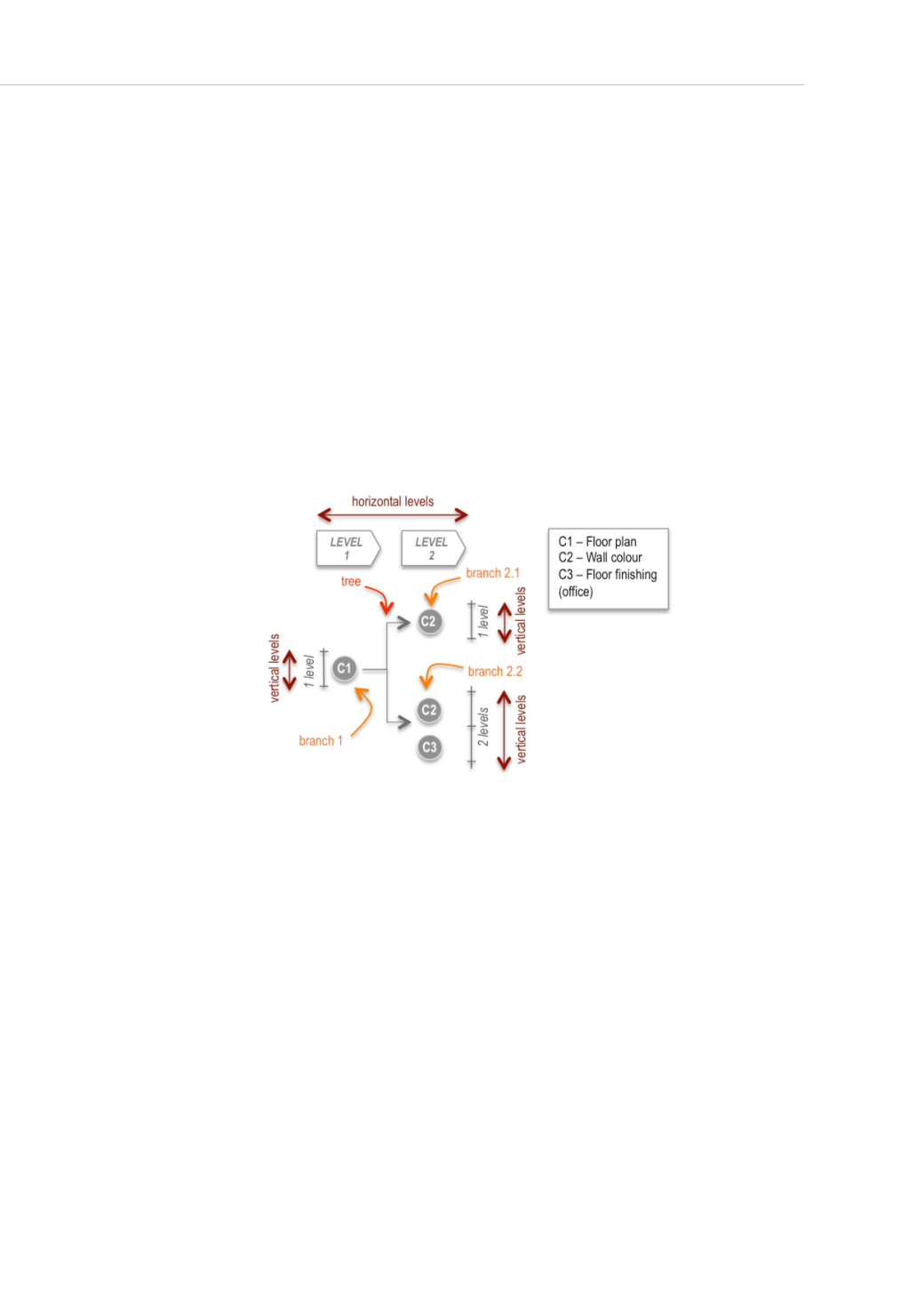
decisions are necessary to define a product variant. In the hypothetical example shown
in
there is a tree that has four decisions. First a decision concerning C1 needs
to be made (i.e. a floor plan needs to be selected). Then a decision concerning C2 and
C3, namely, a floor finishing for the office and a colour for the wall needs to be selected
should be made if the layout previously selected in C1 has an office. If not, only a
decision concerning C2 should be made.
The horizontal and vertical levels express the interdependency among these decisions
. Horizontal levels mark the number of branches that one needs to go through
until making all the necessary decisions to define a product variant. Vertical levels mark
the number of customisation units that needs to be simultaneously considered in each
branch. If a branch contains two customisation units, such as branch 2.2 in
it
means that the decisions concerning these customisation units do not need to follow a
particular order. As illustrated by
each branch has a particular number of
vertical levels: branch 2.2 has two vertical levels, whereas branch 1 and branch 2.1 have
only one vertical level.
Figure 2: Three elements of a configuration sequence (Rocha, 2011)
Considering these elements, four hypothetical types of trees are proposed
.
They are defined as hypothetical because they might not exist in the real world, but
illustrate the implications that distinct decisions concerning these elements can have.
Also most configuration process in the real world cannot be strictly categorised as one
type of three or another, but as a combination of those types.
Type 1 involves only one customisation unit, implying that there is only one vertical and
horizontal level
. This is the simplest configuration sequence. Type 2 has
several horizontal levels but only one customisation unit to be considered at each level
. The advantage of this type of configuration sequence is that the decision
process is simple because it involves the selection of an item of only one customisation
unit at the time. Its drawback is the fact that clients might not have an overview of the
scope of the customisation at the outset once it is gradually communicated as they go
through the configuration process. Type 2 is appropriate when there is an
interdependency or hierarchy among the customisation units. In those cases,
sequentially presenting the customisation units facilitates the configuration process.
Type 3 has a single horizontal level and several vertical levels
. In this type, the
client has to consider several customisation units at the same time. The advantage is


