Z E M C H 2 0 1 2 I n t e r n a t i o n a l C o n f e r e n c e
288
Cambridge, Ontario where it is used as a demonstration and education tool and a "living
lab" or testbed for long term occupancy testing and evaluation.
The thinking presented in this paper has been significantly shaped by a number of key
texts that in aggregate form a background against which the Latitude Housing System
emerges. Joseph Pine’s anticipation and theorization of the ‘experience economy’ as
well as ‘mass customization’ fundamentally reframes models for both the evaluation of
utility and desire within an information economy, and suggests the development of new
models of product delivery that can produce the appearance of the ‘customized’ while
delivering the efficiencies of technologically automated production (Pine 1992,1999).
Stephen Kieran and James Timberlake's manifesto
Refabricating Architecture
has been
instrumental in outlining the potential of lean manufacturing and mass customized
strategies translated from automotive, shipbuilding and aerospace sectors to the building
industry and prioritizing its impact on quality relative to cost and time; a challenge that
will be critical in the delivery of high performance buildings of the future (Kieran and
Timberlake 2003). Perhaps most influential from a conceptual standpoint, however, is
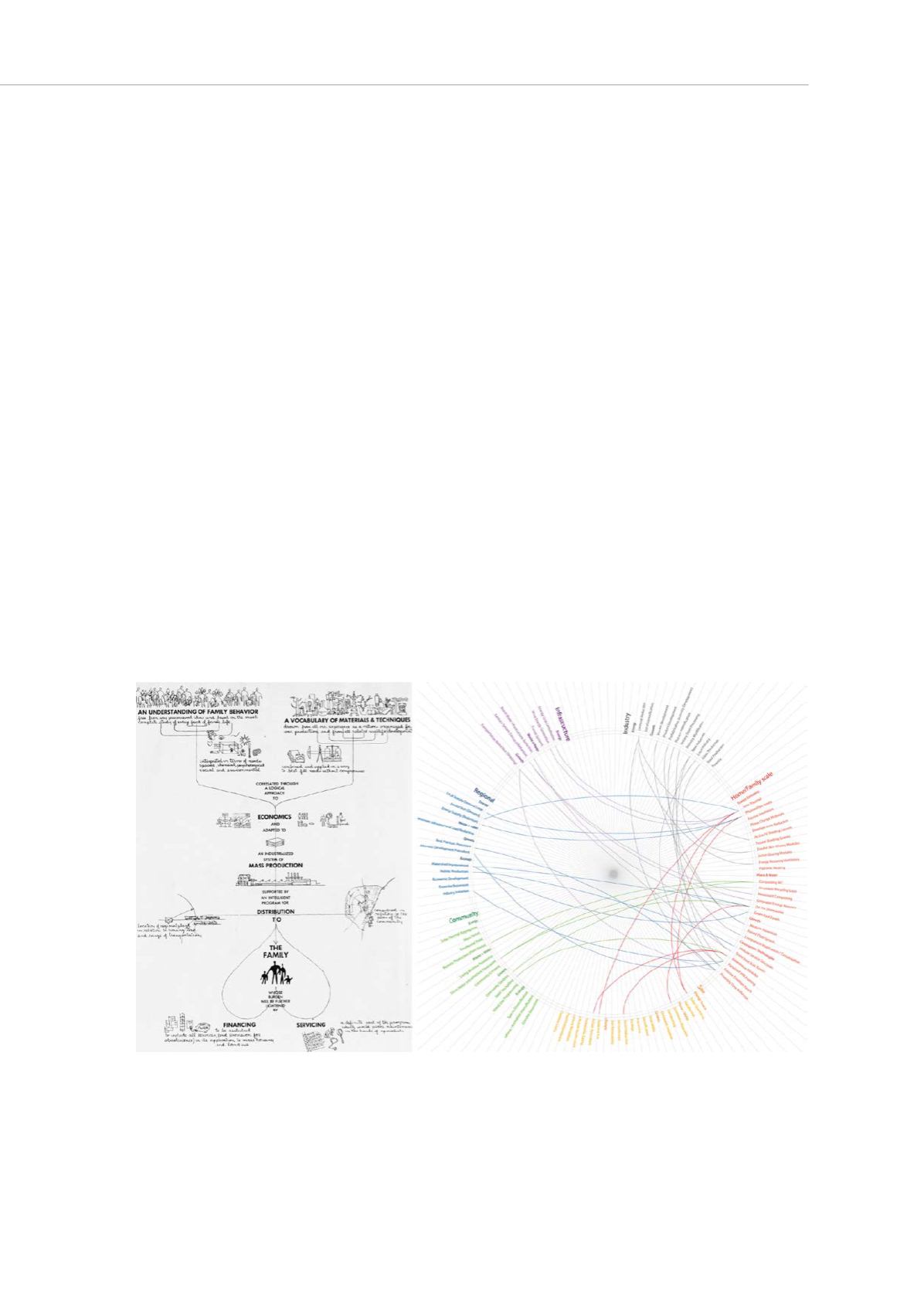
the 1944 essay "What is a House?" famously published to anticipate the Case Study
House Program, it not only called into question the role of the designer and his or her
expertise in working across issues ranging from human behaviour to science and
economics, but also presented a complex network of factors surrounding the condition of
housing delivery (Fig. 1 left) and constituting an ecology of the house (Eames, Entenza,
Matter 1944). Similarly, the Latitude project is founded on the conceptualization of a
"complex ecology matrix" (Fig. 1 right) which serves to unpack and identify the scope
and scale of synergistic activities surrounding net energy producing housing in a near
future context: from fabrication and delivery to urban planning, infrastructural provision
and occupation.
Figure 1: (left) Ecological diagram of industrialized mass-production housing from the 1944 "What is
a House?" published in Arts and Architecture;(right) Complex Ecology Matrix by the authors of
intertwined ecologies of house, site, community, regional, infrastructure and industry.


