L o w C o s t H o u s i n g R a t i o n a l D e s i g n M e t h o d s
373
applicable to residential projects. The analysis of several case studies, both historical
and contemporary, shows two directions always possible:
o
the consumer home: a type of housing project for youth, elderly, people with
disabilities, large families, that multiplies the options to answer to the diversified
needs;
o
the evolutive home: a type of housing that could be changed according to the
evolving needs of the users, namely an adaptable structure.
Both these models refer to the same graduality of flexibility (Grecchi 2006):
o
design flexibility
, that refers to a range of compatible models or options, between
which it is possible to make a choice; this kind of flexibility enacts during the
design process through establishing an extensive repertoire of possible solutions
that meets the needs of future users;
o
use flexibility
, that defines the adaptation potential to the variety of needs that
housing allows in its parts, between the “everything is possible” (the free floor
plan) and spaces that should actually allow this indeterminacy;
o
time flexibility
, that guarantees the possibility of adjustment in time, in relation to
the evolution of the family.
When facing a project, therefore, it is necessary to identify the possible future
arrangements and levels of adaptability during the life span of the building; the notion of
flexibility comes into the design process in a precise moment influencing the choices.
According to the decisions taken during the concept phase, hence, it is usefull to define
three degrees of flexibility (Grecchi 1993): from the
soft flexibility
, feasible without any
increased costs by the user, to the
semi-soft flexibility
, that involves in the design phase
the arrangements of devices for future changes in the connection system with low
increase of the starting construction costs, to the
semi-hard flexibility
that foresees
variations during the use, to finally the
hard flexibility
with high costs when no level of
flexibility was predicted.
Flexibility, thus, is possible only when already in the design phase simple devices are
arranged for future changes, feasible through easy steps done by the users themselves;
these devices establish on one side an increase in the original construction costs, but on
the other side guarantee a reduction of the social and environmental costs in case of
future and different use of the living space. The social distress, meant as social cost,
resulting from changing house and breaking well-established neighbourly relations for a
family that changes its living needs during time, for example, is consequently limited.
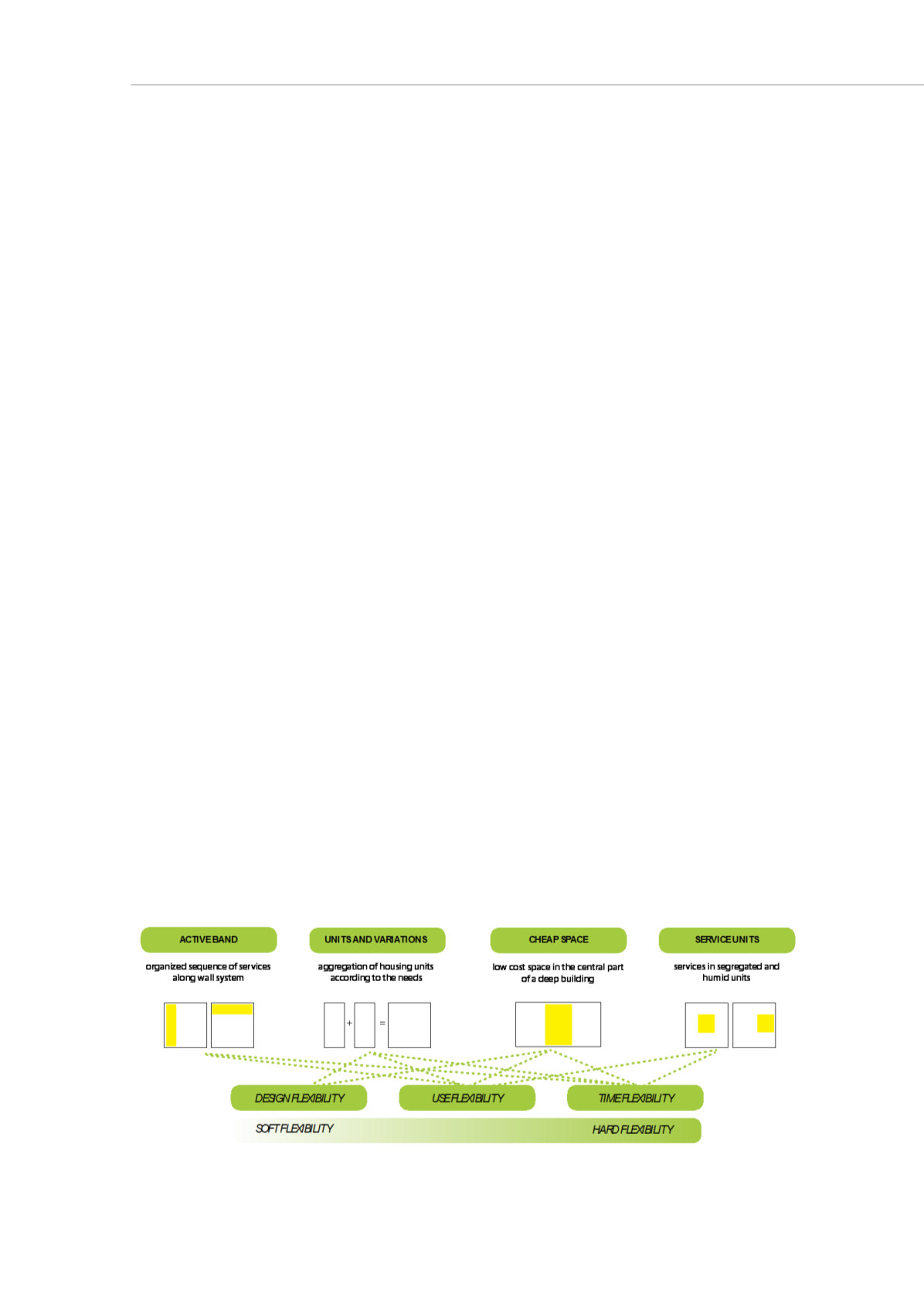
Through the study of the case studies, some typological devices outlined as the most
used and with the highest level of innovation, both in space and use:
Figure 1: Typological devices and degrees of flexibility


