L o w C o s t H o u s i n g R a t i o n a l D e s i g n M e t h o d s
379
These strengths, connected to the economic benefits of mass production and
standardization already highlighted during the reconstruction after the Second World
War and stressed by the Modern Movement, are of new importance in the contemporary
historical period focused in particular on solving the problems of energy efficiency.
In this new context, energy efficiency will surely be the key concept that will open the
gates to renovated industrialization: savings and efficiency from the outset through
controlled design and manufacturing; worksite efficiencies and the savings deriving from
speedier construction; savings and efficiencies during the building’s service life as a
result of technology deployed; and even savings and efficiencies when the building is no
longer usable, preparing it for a “good death”: recycling.
All the foregoing are undoubtedly parameters of considerable significance in the new
sustainability paradigm. Open product catalogues will be needed to recover industry for
architecture: in view of the paucity of such catalogues, the few that do exist must be
modified or “tuned” as a first step toward a renovated industrialization and the
construction of a “low cost and sustainable” public housing project.
In this direction goes the investigation promoted by the competition Housing Contest,
sponsored by Federlegnoarredo in partnership with Milan Municipality, Ordine degli
Architetti, Assimpredil Ance and In/arch, and held in 2011 in Italy. The aim was to
stimulate again the exchange between architects and industry, integrating modern
methods of constructions with the new social and environmental themes. The outcome is
a catalogue of more then 100 housing buildings with a high level of industrialization and
energy saving concepts, which can be useful for those municipalities that wish to build
new public housing with a limited budget and high demands of flexibility to accommodate
different kind of users and energy savings to ensure low running costs.
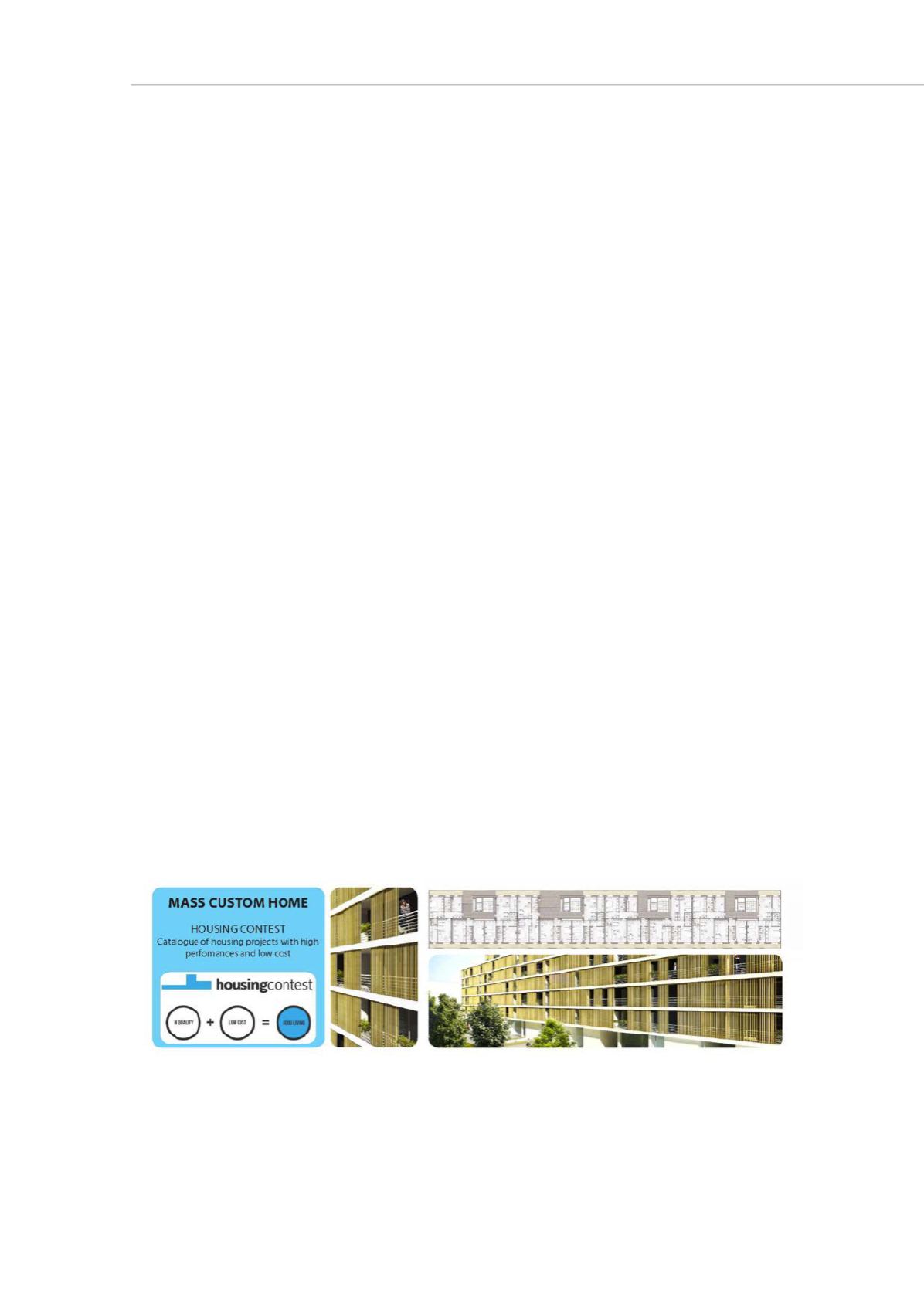
One among many, the project developed by Cogefrin s.r.l. together with Renato Sarno
Group –
case study 6
, develops a prefabricated mixed structure in steel and concrete
that could be built in only 10 months, organized by adding modules to combine different
typologies according to the needs expresses by the users; more over, prefabricated
service units are integrated in the layout for bathrooms and kitchens; the skin of the
building, finally, shows the highest level of industrial tuning in terms of energy saving,
respecting the 30 KW/sqm/year parameter. All these aspects are guaranteed in the
limited budget of 1.080 Euro/sqm, a very low price compared to the average construction
cost in Italy of a building with the same level of performance and quality.
Figure 8: Case Study #6– Cogefrin s.r.l. Housing Contest, Milan – Italy, 2011
The different parameters considered by the jury are referable to the different aspects of
the term “cost” in the new sustainable paradigm: economic, social and environmental
sub-costs were considered both in the design phase than in the construction and running
phase.


