+ H Y T T E . a V e r s a t i l e C o n s t r u c t i o n S y s t e m
387
and ECOTECT+ RADIANCE in order to evaluate the daylight factor inside the building
while varying the glass ratio. Then an excel sheets has been appositively conceived for
verifying ZEB targets accomplishment. PV energy production has been instead
quantified through the use of PVSyst.
Energy Demand and Delivered Energy.
Preliminary energy calculations have been conducted in order to identify the most
effective and robust energy efficiency measures to use in the Norwegian climatic context
(insulation level of different components, use of advanced facades and passive control
strategies), and an appropriate energy supply system (solar, heat pump, combined
cooling, heat and power). On the basis of these preliminary calculations we defined an
adaptation strategy aiming at optimizing the building towards a plus energy house within
the climatic context of Trondheim. Three sets of parameters have thus been identified
with an increasing degree of insulation and air-tightness in order to:
1. Reduce transmission losses through walls, roof, and floor
2. Reduce heat losses through windows
3. Maximize solar heat gains
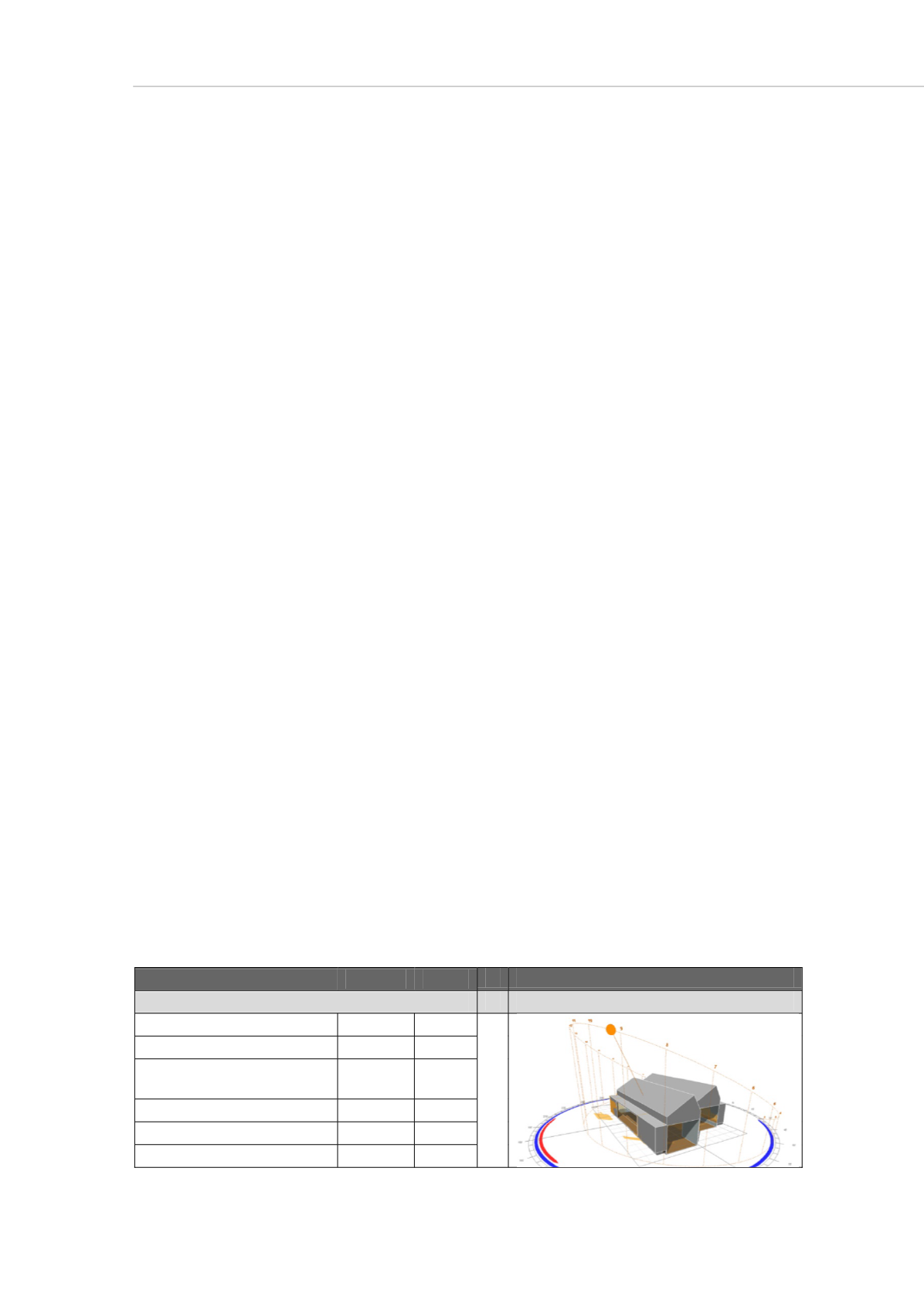
The building modelled inside the software was characterized by a series of values
assumed as constant (reported in table 1) and a series of variable ones (table 2). The
choice of the variables on which it was possible to play has been chosen in accordance
with the concept and construction of the building (materiality and geometry of the window
and roof). Calculations have been performed assuming the use of an air-to-water HP unit
with a COP factor of 2.8 and a ventilation air-handling unit with a heat recovery of 85%
(running in the heating season only with a specific fan power of ca. 1,0 kW/m
3
/s ).
Operation times and internal loads of the building have been fixed according to
Norwegian regulations in force NS 3031.
Internal comfort conditions assumed as target are the following:
• Max air speed winter: 15 cm/s
• Maximum operating temperature dim. Summer: 26 ° C
• Min operating temperature dim. Winter: 26 ° C
• Minimum floor temperature: 19 ° C
• Minimum daylight factor: 2%
Table 1: Simulation model input data.
SIM model input.
unit
GEOMETRY
Heated surface
m
2
106.4
Conditioned volume
m
3
294
Exposed wall surface
m
2
146.8
8
Roof area
m
2
106.4
Windows area
m
2
42,86
South
9,72


