Z E M C H 2 0 1 2 I n t e r n a t i o n a l C o n f e r e n c e
376
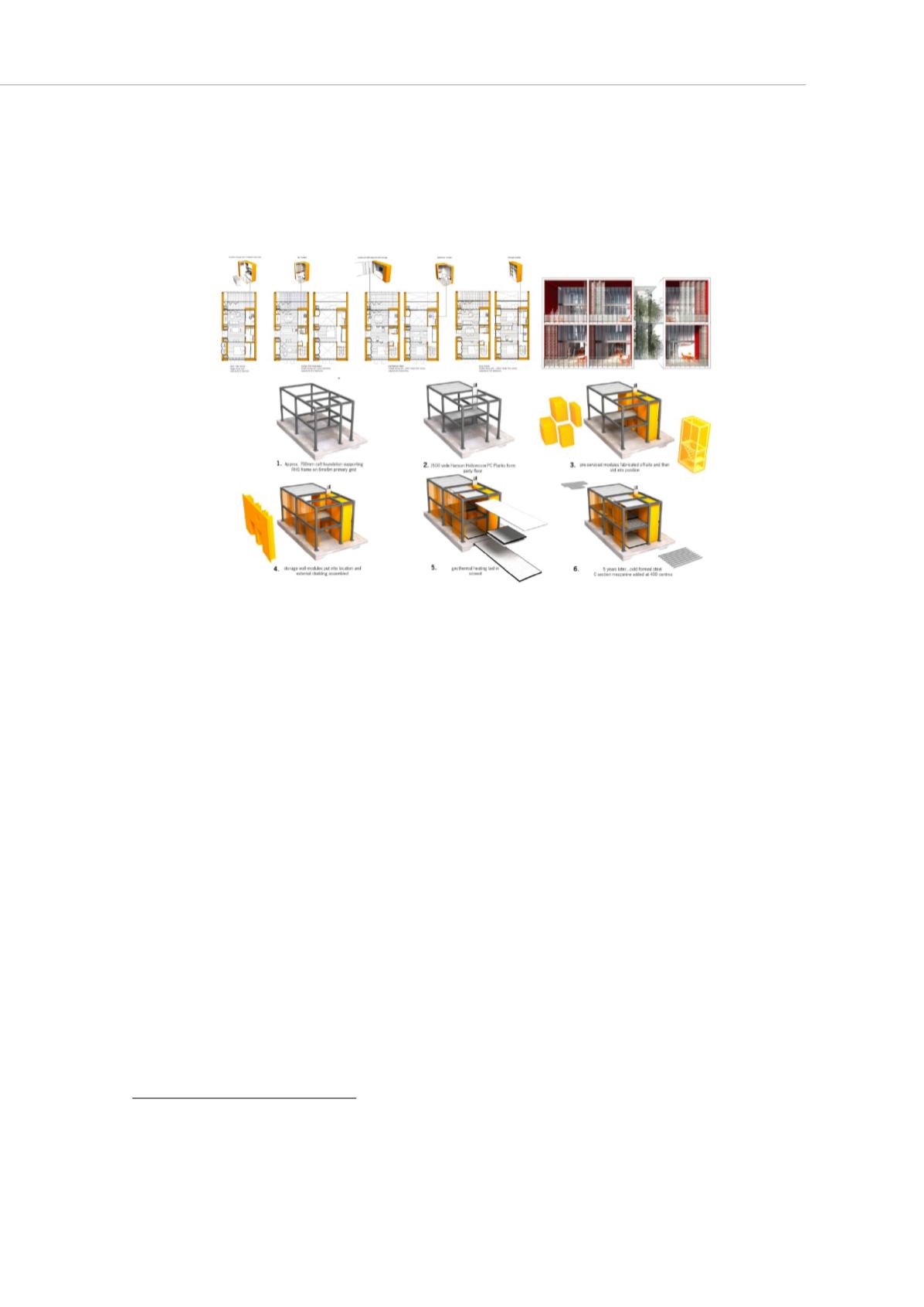
In this direction goes, hence, the project CTRL Space of the Piercy Conner Architects,
winner of the competition ManuBuil
in 2009 –
case study 4
: the designers developed
the project around fixed elements (services, storages, structures) and changeable ones
(materials, mezzanine, partitions), shaping the house not as a sequence of cellular
rooms, but as an aggregation of fluid spaces.
Figure 5: Case Study #4 – Piercy Conner Architects, CTRL Space, 2009
The choice of the right structural system is, therefore, the key point when flexibility is the
pivotal element in a project with “low cost and sustainable” aspects, as long as
sustainability includes economic (low cost in the construction phase due to standard
elements), social (users and their needs) and environmental issues (energy efficiency of
a building).
Different construction systems allow, thus, different degrees of flexibility and
consequently the construction of a certain type of housing: designers should focus on
the one hand on the internal layout to enable different uses of the space, on the other
hand on the
permanent
, the more durable component of the house that constitutes the
frame within which changes can take place (Leupen 2006). The permanent, moreover,
gains in importance when considered together with the environmental issues and the
use of industrialized elements and components is highlighted; among the elements that
compose the permanent (structure, skin, scenery, services and access), structure and
skin are in this meaning the aspects on which designers could better work to achieve
both flexibility and sustainability.
Following this approach, therefore, the research focalizes on the innovative structural
systems used in recent public housing projects, investigating the technological and
energy savings implications, along with the consequences in the quality of the living
space.
6
The European Community sponsored the ManuBuild research in 2006 with the specific goal of
investigating the issue of open industrialization in the construction industry today. The research, which
investigated some of the highlights of low cost housing first from the principles of industrialization, has
informed the content of the international design competition sponsored by EMVS of Madrid for the
formulation of a catalogue of housing projects for the public administration.


