Z E M C H 2 0 1 2 I n t e r n a t i o n a l C o n f e r e n c e
374
These typological devices on the one hand refer all to a clear floor plan layout, on the
other hand they have a wide range of application in the history of architecture. They
guarantee, according to the cases and the levels of flexibility requested,
alterability
, in
case of internal alterations, varying from changing the position of a door or moving or
removing a wall to revising the entire internal layout;
extendibility
, when enlarging the
surface area of a dwelling with or without space-wise consequences for surrounding
houses;
polyvalence
, when multiple uses of space without architectural or structural
modification are necessary in an continuous process. Finally, the same space could hold
different levels of freedom at the same time (Leupen 2006).
The result with the higher level of innovation in the case studies, however, is bringing up
to date these devices throughout the use of modern construction systems and the
parallel integration of energy saving principles. The cost reduction, then, includes not
only the social cost, but also the economic and environmental cost: in one word, the
“generic cost”.
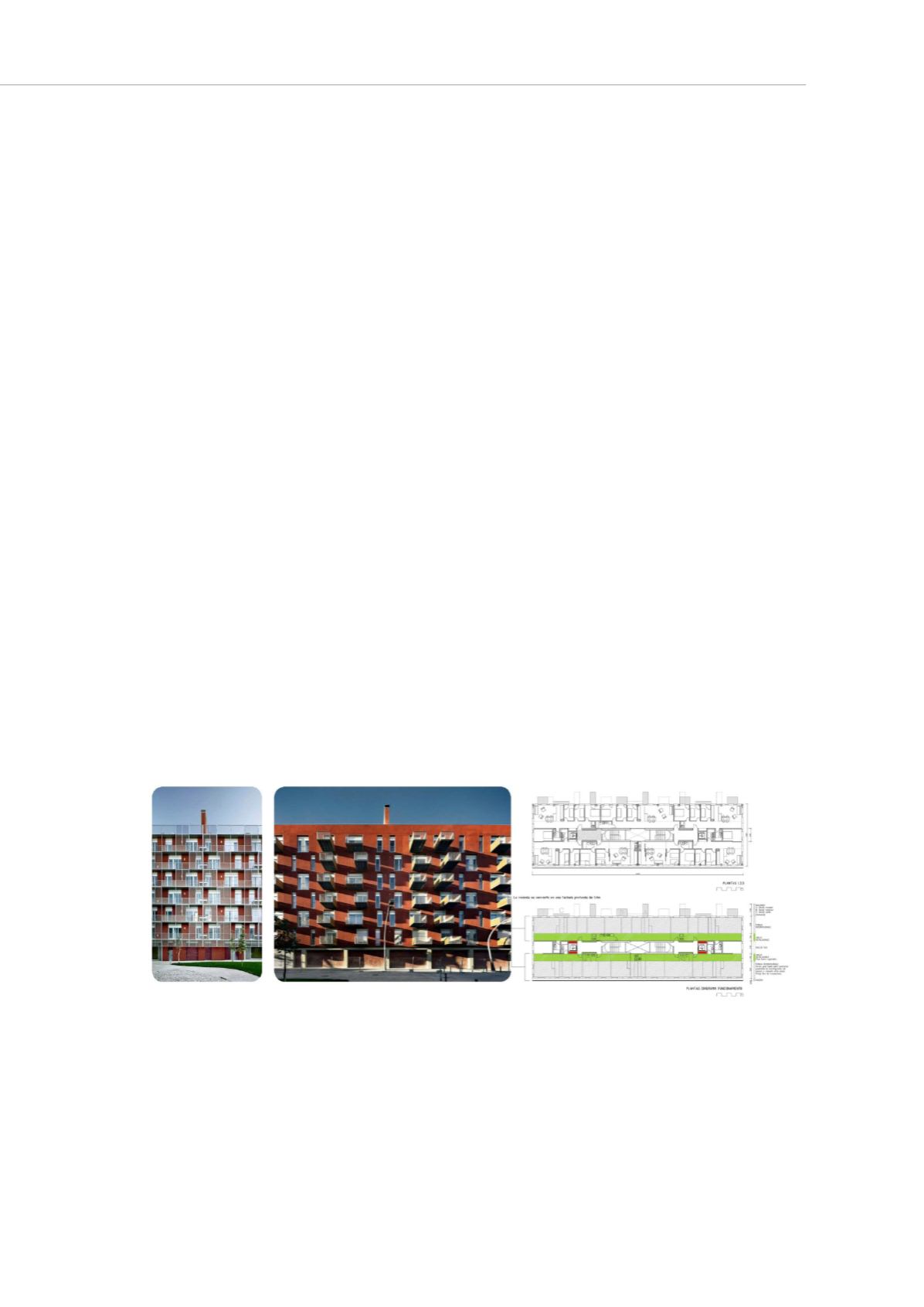
If for example the “band active” is, in fact, a spatial concept date back to the 80’s and
outlined in the research “Domus domain” of Leon e Leclercq, its application in recent
projects, as the housing project of the architects Coll-Leclerc in Barcelona for 42 dwelling
in 2008 –
case study 1
, highlights on the one hand the possibility of increasing the depth
of the building with an improvement of the ratio surface/volume and on the other hand
the extension of the “functional band” concept to a steel frame with function of reduction
of direct sun light on the south-west façade. Band active, hence, not only for the required
internal equipment, but also as an environmental stripe for increasing the global energy
behaviour of the building. Reduction, therefore, of both the social costs due to a total
internal flexibility and the environmental cost in terms of running costs. These
applications are possible, also, thanks to a prefabricated structure, with concrete frames
parallels to the facades connected by floor slabs without in-between columns; the result
allows both a completely freedom in the internal layout with flats along 12mt façade, than
the integration of the double metallic skin hooked to the prefabricated concrete frame
with a dry construction system.
Figure 2: Case Study #1 – Coll-Leclerc, Social housing, Barcelona – Spain, 2008
In the same way, the project of the architects Aranguen&Gallegos for the EMVS in
Madrid in 2003 –
case study 2
, shows an extremely deep building organized along a
central stripe of services. Also in this case, the intrinsic limit of this layout is clear: all the
flats open only on one side. The restriction in the use of the liveable space, however, is
compensated by a high level of sperimentation on the internal layout, thanks to the
height of the service band higher then the internal one. In this way, it is possible to


