Z E M C H 2 0 1 2 I n t e r n a t i o n a l C o n f e r e n c e
618
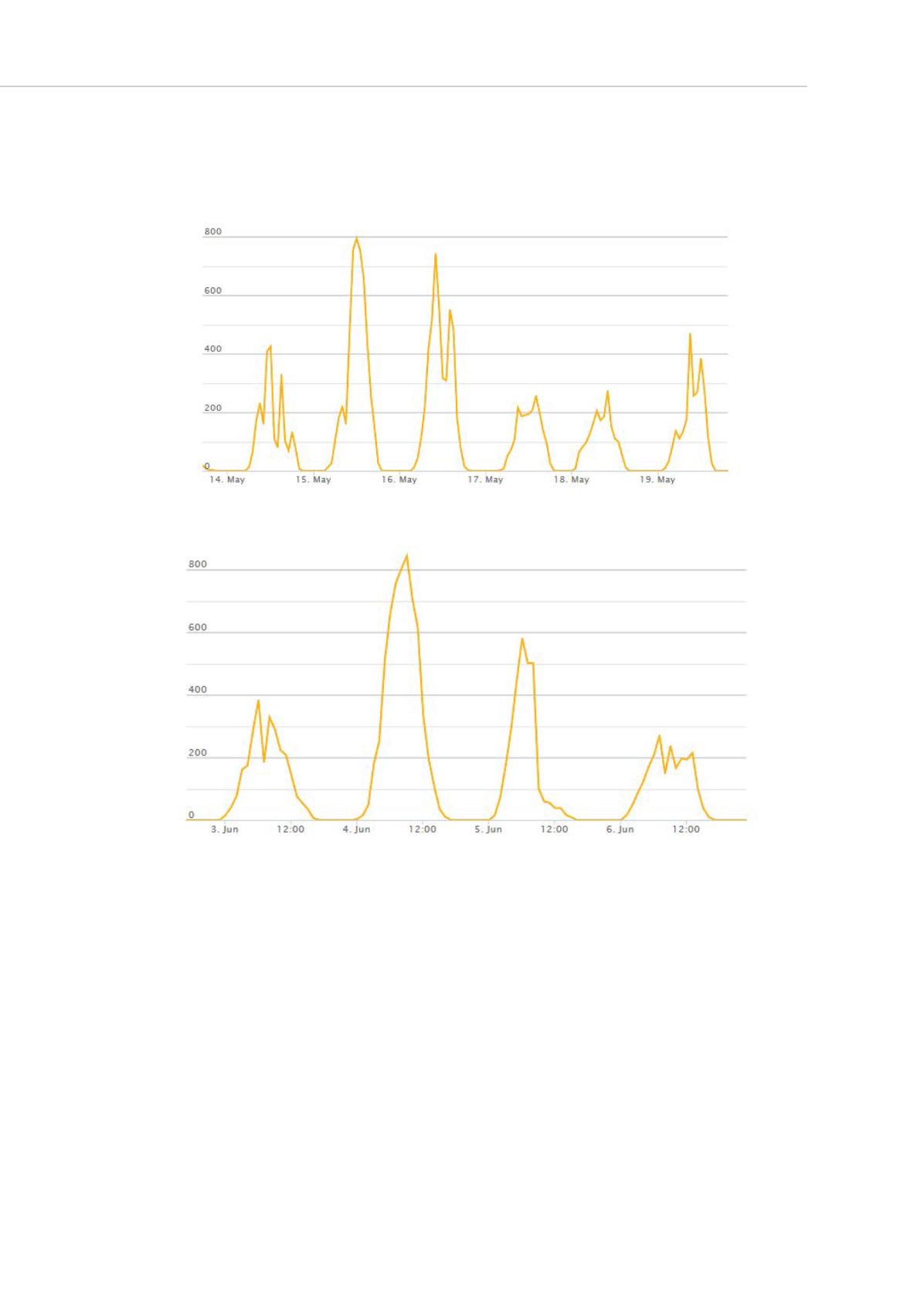
The monitoring results indicate that the incoming solar radiation recorded at the site had
never exceeded 900 W/m
2
and the intensity of the morning sun tends to be stronger than
that of the evening (Figs.8 & 9).
Figure 8: Measured solar data from 14
th
May 2012 to 19
th
May 2012
Figure 9: Measured solar data from 3
rd
June 2012 to 6
th
June 2012
The Power Predictor
TM
has an additional capacity for predicting the potential amount of
electricity that can be generated by the installation of PV arrays. Although it is an
approximate estimation, it still helps identify the economic value of the product, which is
helpful for purchase decisions. For instance, when Kyocera KD 2.7kWp multi-crystalline
PV modules accompanied by 16.3% conversion efficiency are installed in the house, the
device estimates the electricity generation at 3,863 kWh per annum. The average
electricity consumption of the house was observed over the period of nine months and it
was 602.8kWh. Considering that the annual electricity requirement of the house is
7,234kWh, the PV can cover almost half of the consumption. When the Feed in Tariff
(FIT) Rate is £0.21/kWh and the Export Tariff is £0.03/kWh, the income from PV power
could be estimated at £811.23 and additional £115.89 could be gained from the
electricity export. Moreover, 50% of the PV power generation was used locally reducing
the amount of import energy to 5,303kWh/annum. Under this condition, the total income


