E x a m i n i n g C o s t – E f f e c t i v e n e s s o f P V / T M V H R S y s t e m s
619
by installation of the PV modules become £1,722.57/annum if the retail price of electricity
is considered to be £0.15/kWh. The capital cost of the PV array in question is £14,559.
The payback period could be estimated roughly at 8.5 years. The inverter may need to
be replaced then; however, the installation still benefits to the house owner over the
period of 25 years which FIT scheme applied should be valid.
The data collected at the site led to indentifying the close approximation of solar benefits
when PV is applied to the dwelling in question. However, the Power Predictor
TM
disregards significant impacts of PV modules’ actual sloping angle and orientation when
estimating the power generation. The following sections provide more detail information
on how PV/T system can actually perform when the sloping angle and orientation are set.
PV/T Performance Overview
Prior to the review of PV capacity for thermal energy generation, PV power generation
potential was estimated using the PVGIS interactive map (European Commission 2012).
The location was specified based on the proposed housing development site—i.e. the
latitude at 55
o
29'33" North and the longitude at 4
o
36'28" West. In this study, 4kWp
crystalline silicon modules were selected assumed to be installed in the 30
o
angled
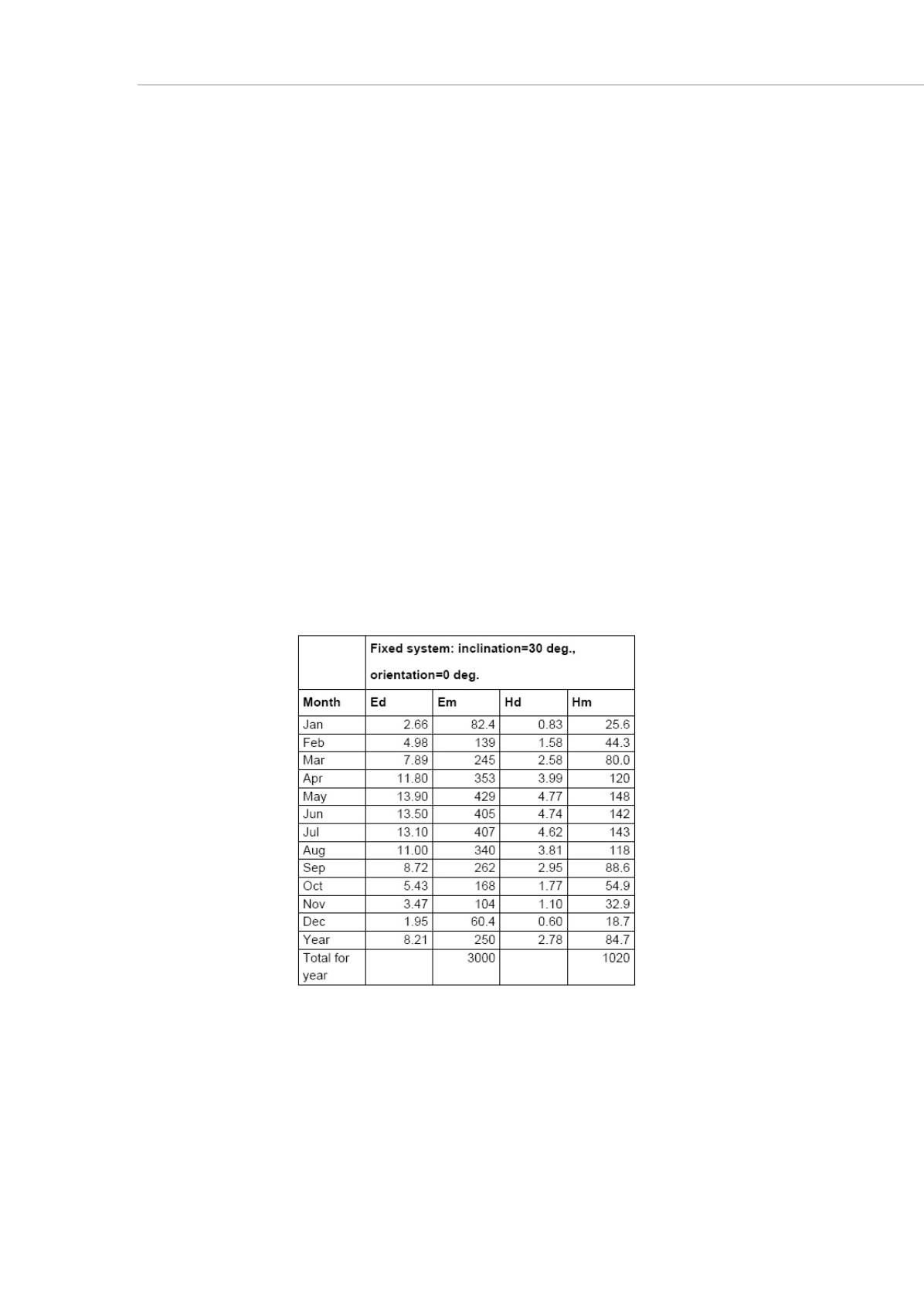
south-facing roof of the house in question. The simulation indicates that the selected PV
can generate 3,000 kWh of electricity annually (Table 1 and Fig.10).
Table 1: 4kWp crystalline silicon PV electricity generation in Prestwick based on PVGIS simulation
Ed:
Average daily electricity production from the given system (kWh)
Em:
Average monthly electricity production from the given system (kWh)
Hd:
Average daily sum of global irradiation per square meter received by the modules of the
given system (kWh/m
2
)
Hm:
Average sum of global irradiation per square meter received by the modules of the given
system (kWh/m
2
)


