T h e r m a l I n s u i a t i o n P r o p e r t i e s o f L i g h t – W e i g h t F o a m e d C o n c r e t e
639
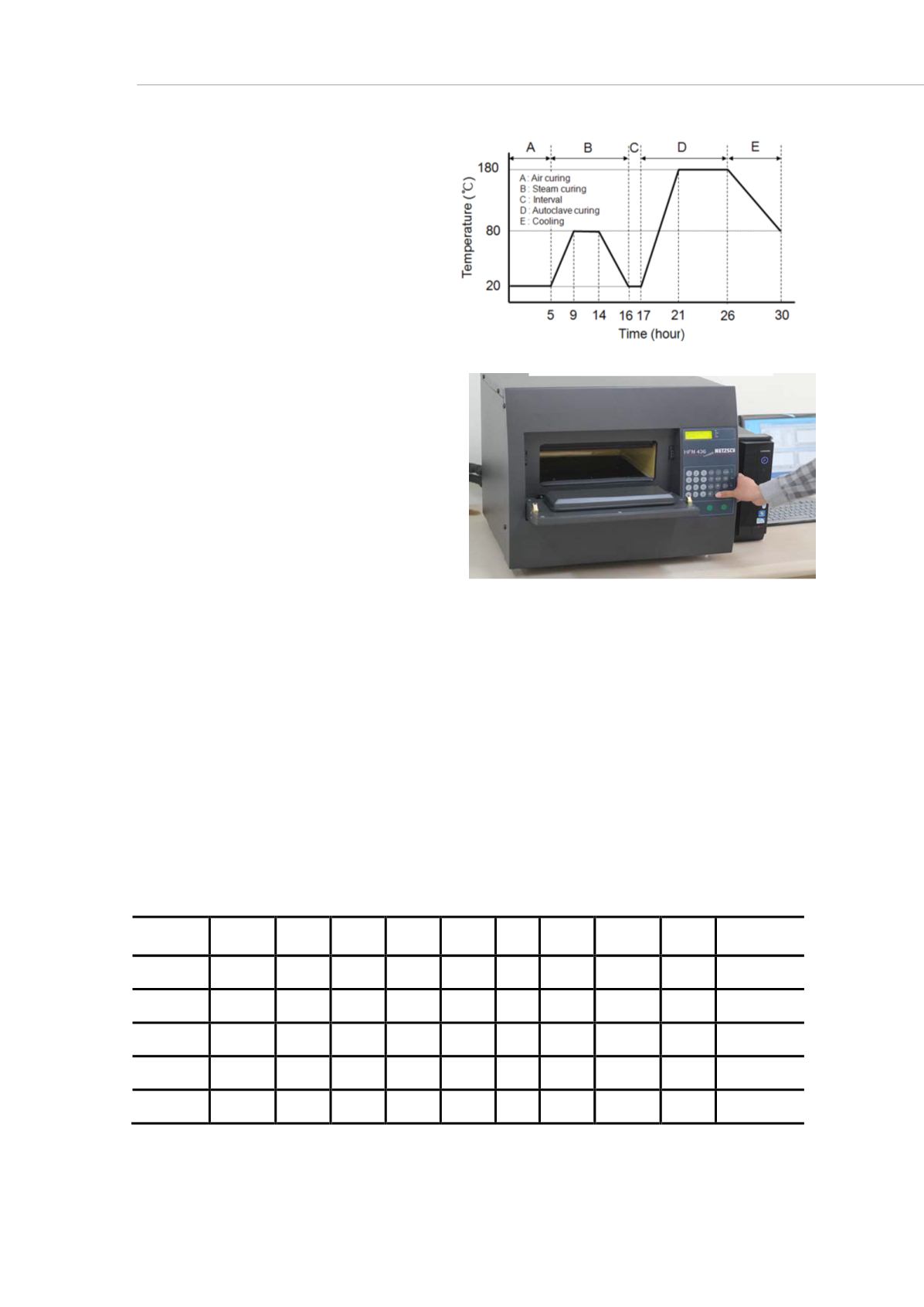
As shown on Fig. 2, curing is
implemented in a total of 3 phases; pre-
curing, steam curing, and autoclaved
curing. The pre-curing is to minimize
the loss of foam added to the paste
that
it has been implemented for 5 hours
under the room temperature of 20±2
℃
.
The steam curing was carried to
manifest the strength to resist to the
outside impact arising during the works
after the mold removal to the
autoclaved curing that it was implemented
for 5 hours at 80
℃
.
Lastly, the autoclaved curing was carried
out with the purpose of manifesting the
target strength by attracting the reaction
of CaO and SiO
2
that it was implemented
for 5 hours under the conditions of 180
℃
and 10 atm.
In the meantime, the thermal
conductivity was measured by using the
HFM 436 model of Netzsch, Germany of
Fig. 3 with the subject of the foam
concrete panel formulated in the
(300×300×50) mm type. The average
temperature has the scope of 21±3
℃
under the hardening condition and the thermal direction is set to the upside.
2.3 Materials used
For the cement, it used ordinarily Portland cement, and the alumina cement uses the
un-solidified light-weight foam concrete with the air gap structure to prevent the small
foam phenomenon of the foam. The slaked lime is added for promoting the hydration of
the calcium silicate compound while the anhydrous gypsum is added for early quick
setting prevention of the alumina cement. The chemical characteristics of the material
used is shown in Table 3.
Table 3. Chemical composition of binders
Types
CaO
SiO
2
Al
2
O
3
MnO Fe
2
O
3
SiO
3
K
2
O
SrO
ZrO
2
TiO
2
PC
72.1
11.2
2.24
0.10
5.49
5.22
2.68
0.14
0.02
0.31
AC
37.1
2.78
59.8
0.04
0.22
-
-
0.03
0.01
-
Q
1.23
88.1
5.02
0.08
3.45
-
1.52
-
0.04
0.44
CH
93.8
1.37
0.59
0.09
1.44
1.53
-
0.07
-
-
AG
38.0
2.28
0.82
-
0.16
58.6
-
0.12
-
-
Figure 2 : Curing method
Figure 3: Thermal conductivity measuring
equipment


