T h e r m a l I n s u i a t i o n P r o p e r t i e s o f L i g h t – W e i g h t F o a m e d C o n c r e t e
641
3.3 Compressive strength
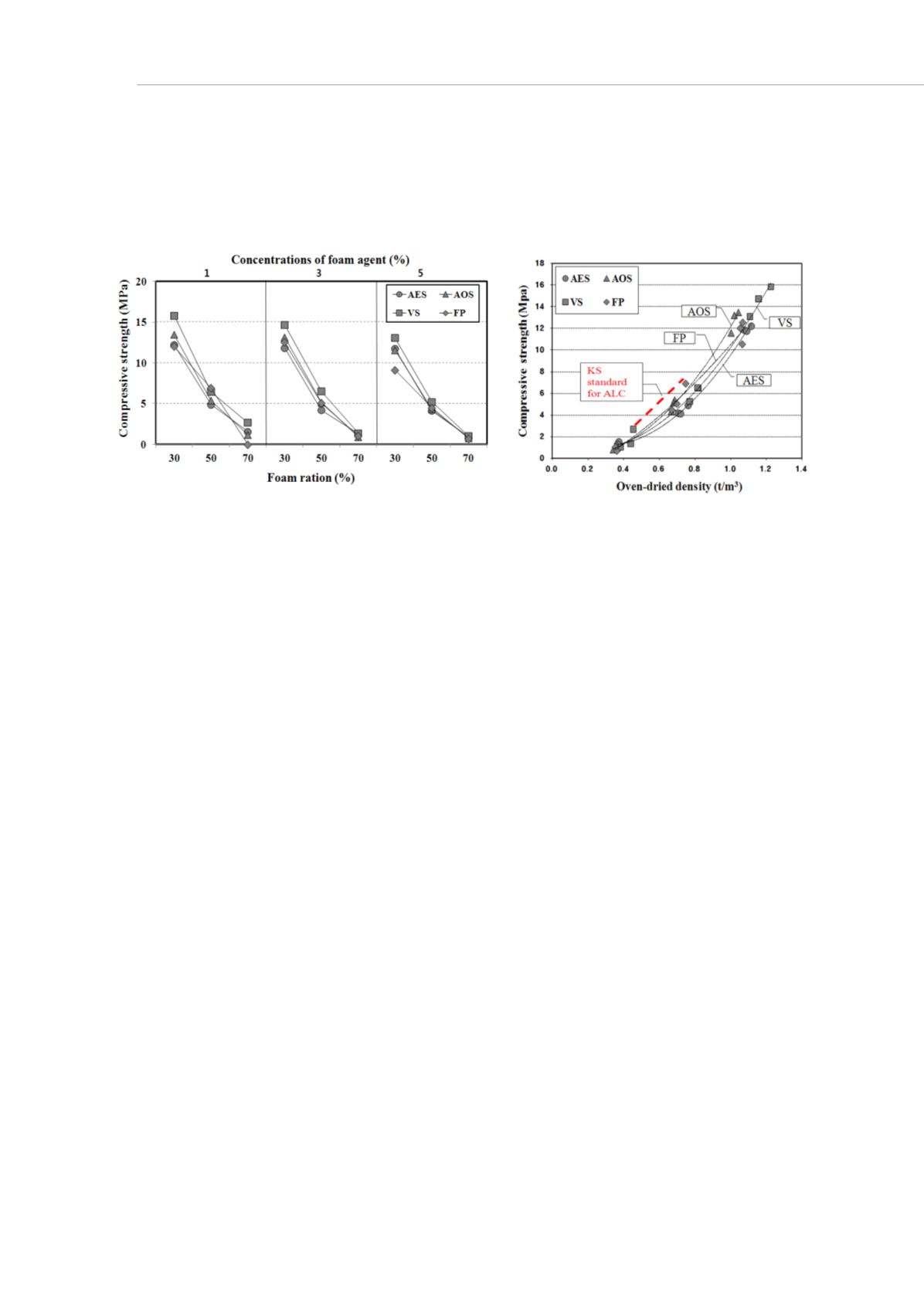
The compressive strength experiment result of the hardened foam concrete is shown on
Figure 7. The strength is lowered in accordance with the increase of foam rate.
The relationship of the strength and foam rate shows the less index relationship for the
strength difference of 50% and 70% for the foam rate than the strength difference of the
foam mixture rate of 30% and 50%.
Looking into the influence following the foam types, it generally showed higher strength
when using VS, and it showed lower strength for using FP without significant difference.
With the exclusion of the foam agent strength of 1%, the deviation of strength following
the foam agent type increased in accordance with lower foam contents. As the foam
agent concentration increased, the strength shows the tendency of slight decline, but this
tendency is clear only in the case of foam mixture rate of 30% and it does not show
much at all in the foam mixture rate of 50% and 70%.
The relationship of the dried density of the hardening condition and the compressive
strength of the hardening condition is shown on Figure 8. The data for the experiment by
the post-foaming method showed the similar level at the same strength level of existing
ALC. However, under this study, the density change has become diversified that it
manifests 16 MPa of compressive strength for a very high level compared to the strength
of the ALC product.
In the relationship of density and compressive strength, there was no showing of
influence following the foam agent in relatively low density level, but in the event of the
density of 0.7 or more, there is a difference following the types of the foam agent. Under
the same density, the strength has increased to the level of AES, VS, FP, and AOS, but
since the number of the specimen is not significant, the tendency is slightly not so clear.
3.4 Thermal conductivity
Figure 9 and 10 showed the thermal conductivity measurement result of foam concrete
panel following the types of foam agent, diluted concentration, and foam rate. It is the
natural result, but as the foam rate increased, the thermal conductivity decreased.
Depending on the type of foam agent, the thermal conductivity of the test body that used
AOS, AES, VS, and FP was shown to be 0.09
∼
0.39, 0.11
∼
0.35, 0.10
∼
0.30, and
0.09
∼
0.27 W/mK. In the specimen that used natural material foam agent, VS and FP,
relatively outstanding thermal conductivity was shown.
Figure 7 : Variation of compressive strength according
to foam ratio and concentrations of foam agent
Figure 8 : Relationship between of
slurry and oven dried density


