Z E M C H 2 0 1 2 I n t e r n a t i o n a l C o n f e r e n c e
642
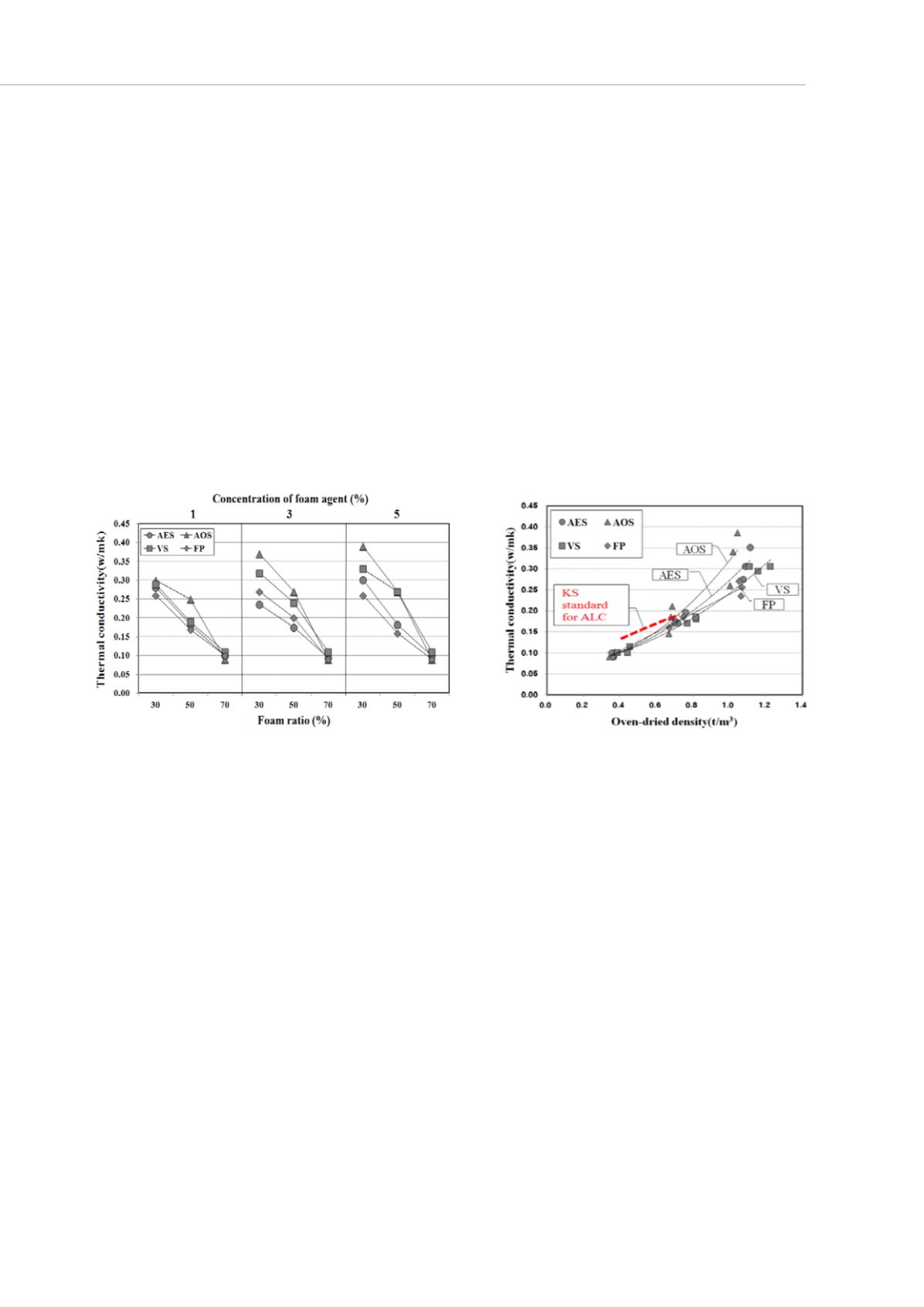
In addition, in the low density area of the foam rate for 70%, there was almost no
difference of the thermal conductivity following the foam agent type, but it showed
significant different in accordance with the reduction of the foam rate. In the foam rate of
30% and 50%, the difference of dilution concentration of 1% and 5% has maximum of
0.15 W/mK, and consequently, in the event that FP or VS is used in dilution of 3% or
more, it has the most outstanding insulation capability as the foam concrete insulation
panel. Comparing the specimen that used FP and AOS, the thermal conductivity at the
similar density level showed the difference of up to 0.1 W/mk.
Also, all specimens excluding some of the AOS satisfied the thermal conductivity
standard for the <KS F 4039, field pouring foam concrete> as regulated in Korea. In the
meantime, as the dilution concentration is higher, the thermal characteristic is shown to
be excellent that it requires the use for appropriate dilution concentration in consideration
of the mechanical performance and insulation performance.
In addition, the thermal conductivity of the foamed concrete in the pre-foaming method
under the experiment showed a slightly lower thermal conductivity figure in the same
density level compared to the ALC product of KS.
4.
Conclusion
1) With the adjustment of the dilution concentration and foam rate of the foam agent,
manufacturing the light foam concrete with the pre-foaming method is available, showing
lower thermal conductivity under the same density with greater range of density
compared to the ALC of the post-foaming method.
2) The compressive strength is more outstanding for AOS or FP and thermal conductivity
have more outstanding figures in FP and VS
3) The optimal condition when manufacturing the foam concrete under the pre-foaming
method is shown to be 3% for dilution concentration, with the foam agent for FP of
animal foam agent.
Acknowlegement
This study was supported by the Regional Cooperation Project of Ministry of Knowledge
Economy, Human Resources Development of the Korea Institute of Energy Technology
Evaluation and Planning (KETEP) grant funded by the Korea government Ministry of
Knowledge Economy (No. 20114010203040) and by the R&D Center for Valuable
Recycling(Global-Top Environmental Technology Development Program) funded by the
Ministry of Environment.(Project No.:11-C21-ID)
Figure 9 : Variation of thermal conductivity according to
Foam ratio and concentrations of foam agent
Figure 10 : Relationship between of
Thermal conductivity and oven-dried density


