Z E M C H 2 0 1 2 I n t e r n a t i o n a l C o n f e r e n c e
712
state-of-the-art high-performance insulation technology is required. In this context, VIPs
(Vacuum Insulation Panels) for high-performance building envelopes were recently
introduced in the building sector. The heat resistance of VIPs is greater than that of
conventional insulation materials such as polystyrene, polyurethane foam, and glass
wool. VIPs have an insulation performance that is 5-8 times greater, allowing for the
application of a high-performance insulation envelope as a thin insulation layer on
buildings (Simmler
et al
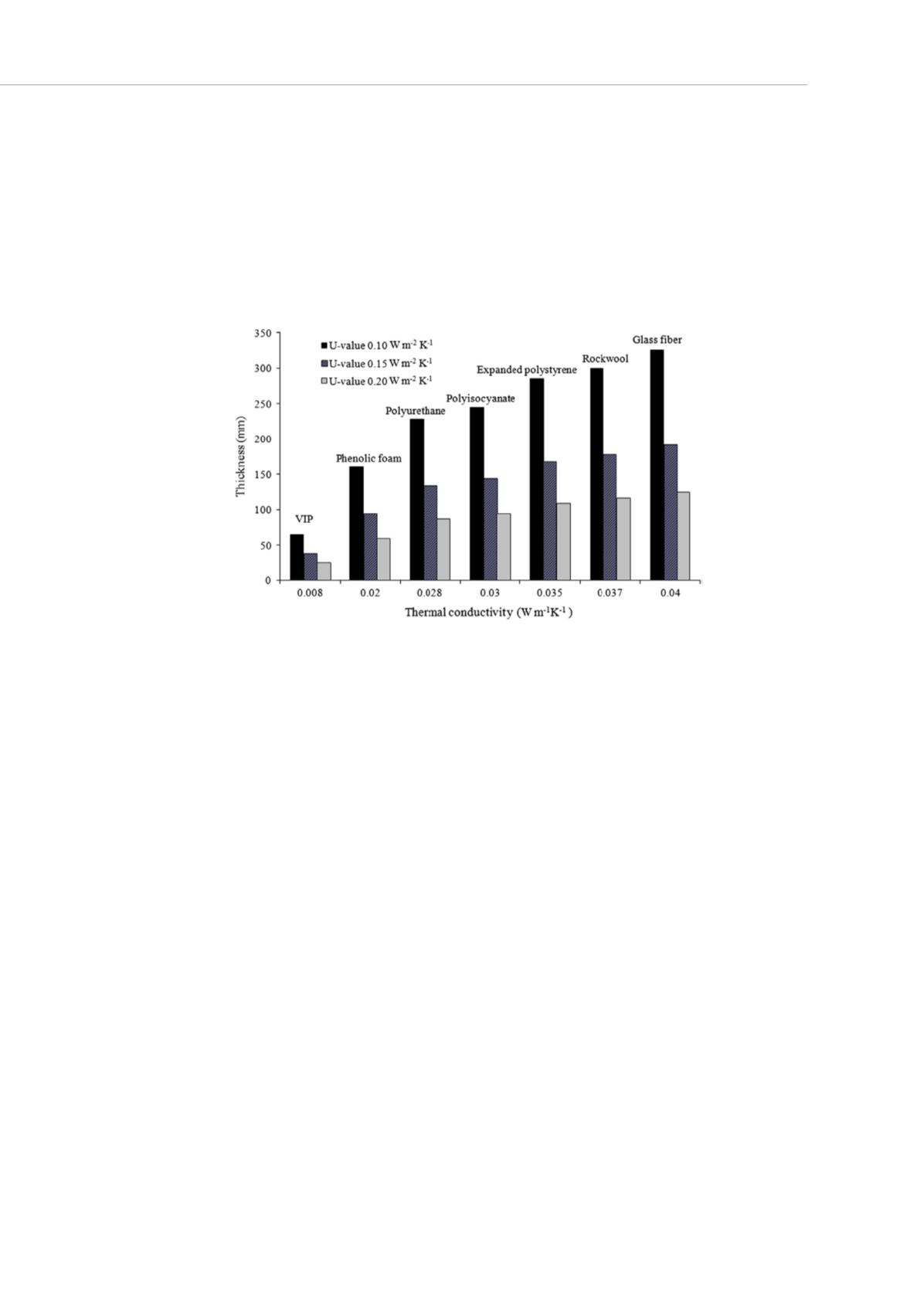
. 2005:1). Figure 1 shows a graph of the thicknesses of various
conventional insulation materials along with VIP as needed to achieve different U-values
(W m
-2
K
-1
) (Alam
et al
. 2011:3593).
Figure 1: Thickness of the different insulation materials required to achieve different U-values (Alam
et al.
2011:3593)
However, VIPs are weaker against impacts compared to conventional insulation
materials, and their small size requires additional attention according to the installation
method. In particular, the application of VIPs in buildings increases the concern for heat
loss structurally in the form of a thermal bridge at the panel edges due to the attachment
methods and the effects of any adjacent materials. The thermal bridge effect increases
the heat loss and may reduce the insulation performance of the building envelope when
VIPs are applied. Therefore, for an optimal method with which to apply VIPs, it is
important to prevent thermal bridges and minimize their effects.
From 2001 to 2004, some researchers from various countries, including Switzerland and
Germany, conducted a study on VIPs through the IEA/ECBCS Annex 39 “HiPTI-High
Performance Thermal Insulation” international research project (Moosmann
et al.
2005).
Applications of VIPs to floors, roofs, terraces, nonbearing wall sandwich panels,
guardrails, and prefabricated envelopes were investigated. Also, matters that require
attention and recommendations regarding VIPs as they are applied to buildings were
presented.
Other investigations include a study in which VIPs were applied to a monosloped roof
structure, after which the thermal performance was analyzed according to the internal
pressure changes in the VIPs, which directly influence the thermal conductivity and
thermal transmittance (Brunner and Simmler 2008). Also, the thermal performance
depending on the envelope finishing material and the thickness of VIPs applied to a
wooden door system was studied (Nussbaumer
et al.
2005).
Additionally, a study that investigated the internal pressure difference depending on time
and the pressure increase due to temperature changes was presented. This also studied
the basic characteristics as well as aging and durability issues. Simmler and Brunner
(2005) predicted a thermal conductivity variation range of 0.006 W m
-1
K
-1
~ 0.008 W m
-


