A n E x p e r i m e n t a l P e r f o r m a n c e C o m p a r i s o n o f V I P s W a l l
713
1
K
-1
with respect to the 25-year useful lifetime of silica VIPs. Kwon
et al
.(2009) evaluated
the correlation between the thermal conductivity and the gas used according to the
internal gas pressure changes for various core materials. Moreover, the lifetime
depending on internal pressure changes for single- and double-envelope VIP materials
was assessed (Kwon
et al
. 2010).
VIPs cannot be considered as a conventional building insulation material but rather they
have to be viewed as a type of building insulation system that combines VIPs and their
attachment method. The thermal bridges of VIPs affect the overall thermal performance
of the building envelope(Baetens
et al
. 2010). A considerable amount of research has
been conducted regarding estimation of the effects of the envelope barriers of VIPs and
of structural thermal bridges. In particular, the thermal performance varies significantly
with the thickness of the aluminum foil that is used to wrap the core bag, and the thermal
bridge effect. Ghazi
et al
.(2004) used the TRISCO simulation tool, a two-dimensional
numerical analysis tool, to predict the effective thermal conductivity while using a
guarded hot box to measure the effective thermal conductivity and calculate the linear
thermal transmittance. Thorsell and Kallebrink (2005) used the Femlab simulation tool to
calculate the linear thermal transmittance at the edges of a VIP. Tenpierik
et al
.
calculated and compared the linear thermal transmittance depending on the aluminum
thickness with different metallic envelope materials (Tenpierik
et al.
2008, Tenpierik and
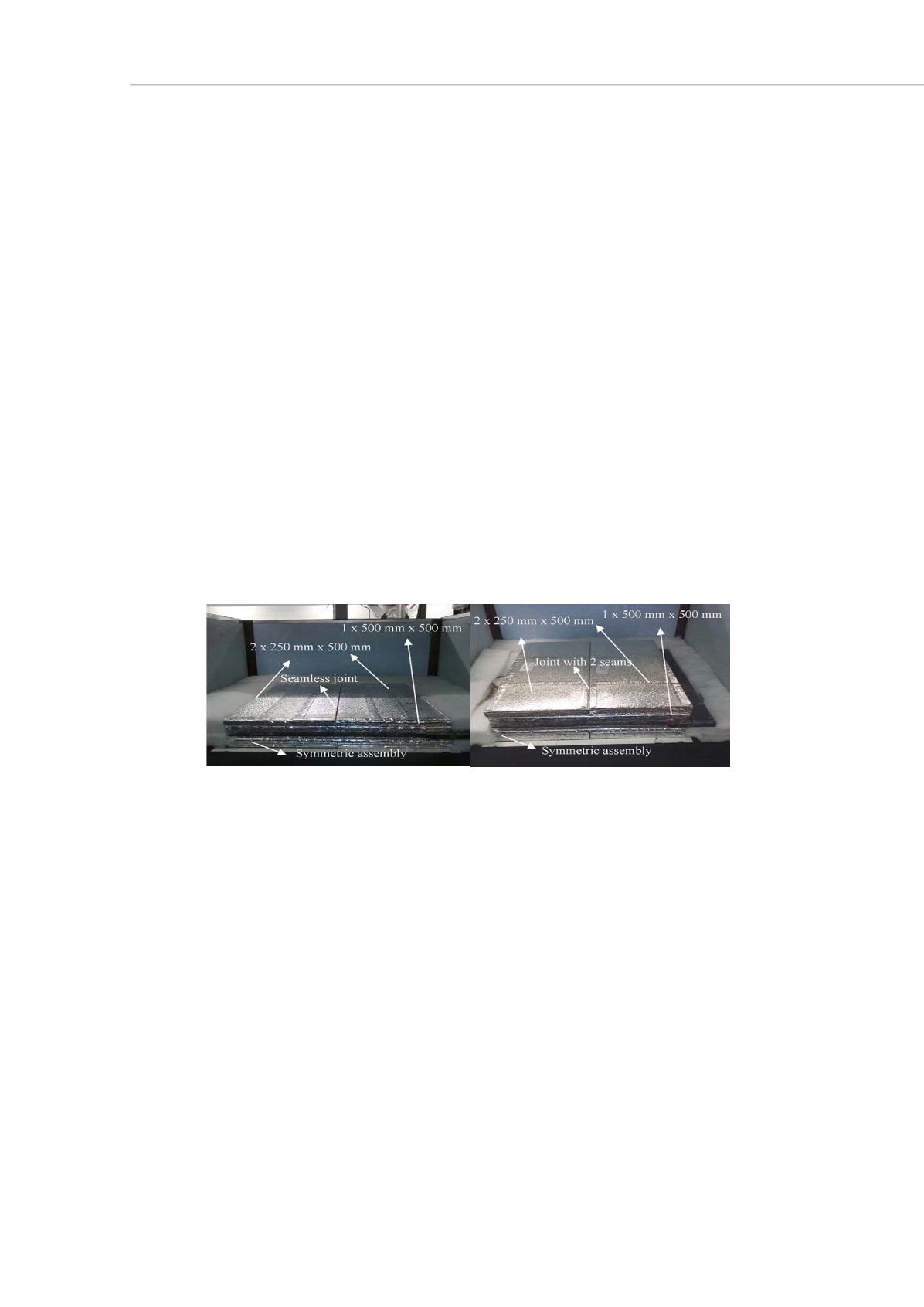
Cauberg 2007). Ghazi et al. performed guarded hot box experiments on five different
models (Fig. 2) with different VIPs thickness and seam types in the joint between panels
in order to compare the linear thermal transmittance characteristics due to thermal
bridges (2011).
Figure 2: The built in situation for the measurement of λ
eff
for no seams in the joint (left) and two
seams in the joint (right) (Ghazi
et al
., 2011:1243)
The aim of this study is to evaluate thermal performance of VIPs wall taking into account
the thermal bridge effect of VIPs installation methods. For this study, two experimental
model of building wall with VIPs were designed and constructed. The U-value of the two
walls was measured using thermal performance testing equipment, and the results were
compared. Furthermore, the thermal bridge effect of the VIPs walls was confirmed with
infrared thermography.
Building wall with VIPs and experimental method
The VIPs used in this study use fiber glass as a core material in the core bag wrapped
with multilayer films of nylon and aluminum. The VIP used for this study is presented in
Figure 3. The size of the VIP is 500 mm by 800 mm with a thickness of 10 mm. The
thermal conductivity(k) at the center of the panel is 0.003 W/(m·K). However, k-value can
increase by 0.001~0.002 W/(m·K) depending on the thermal bridge effect at the edges of
the panel (Kim and Kim
2009:244).


