Z E M C H 2 0 1 2 I n t e r n a t i o n a l C o n f e r e n c e
716
With the measurement results of the two different types of VIP installation method, the
VIP walls of the joiner type and wooden lath type have U-values of 0.165
W/(
2
∙ K)
and
0.267
W/(
2
∙ K)
, respectively, as presented in Table 1. Thus, the VIP wall of joiner
type had better thermal resistance performance than the VIP wall of wooden lath type.
Table 1: U-value of two types VIP wall
U-value
[W/(
2
∙ K)]
Joiner type
0.165
Wooden lath type
0.267
In the VIP wall with installation method of two different types, the wooden lath and the
thermoplastic joiner are the connecting components of VIPs, and their thermal
conductivities are 0.13 W/(m K) and 0.25 W/(m K) respectively. Thus, the thermal
conductivity of the wooden lath is lower than that of the thermoplastic joiner. However,
the experimental results showed that the U-value of VIP wall of joiner type is lower than
that of wooden lath type. This is believed that the wooden lath type has larger
connecting area than the joiner type. In the case of the joiner type, the highly efficient
thermoplastic was used and this type of installation material has the advantage of using
a thinner configuration that gives an advantage in achieving better overall thermal
performance of the VIP wall.
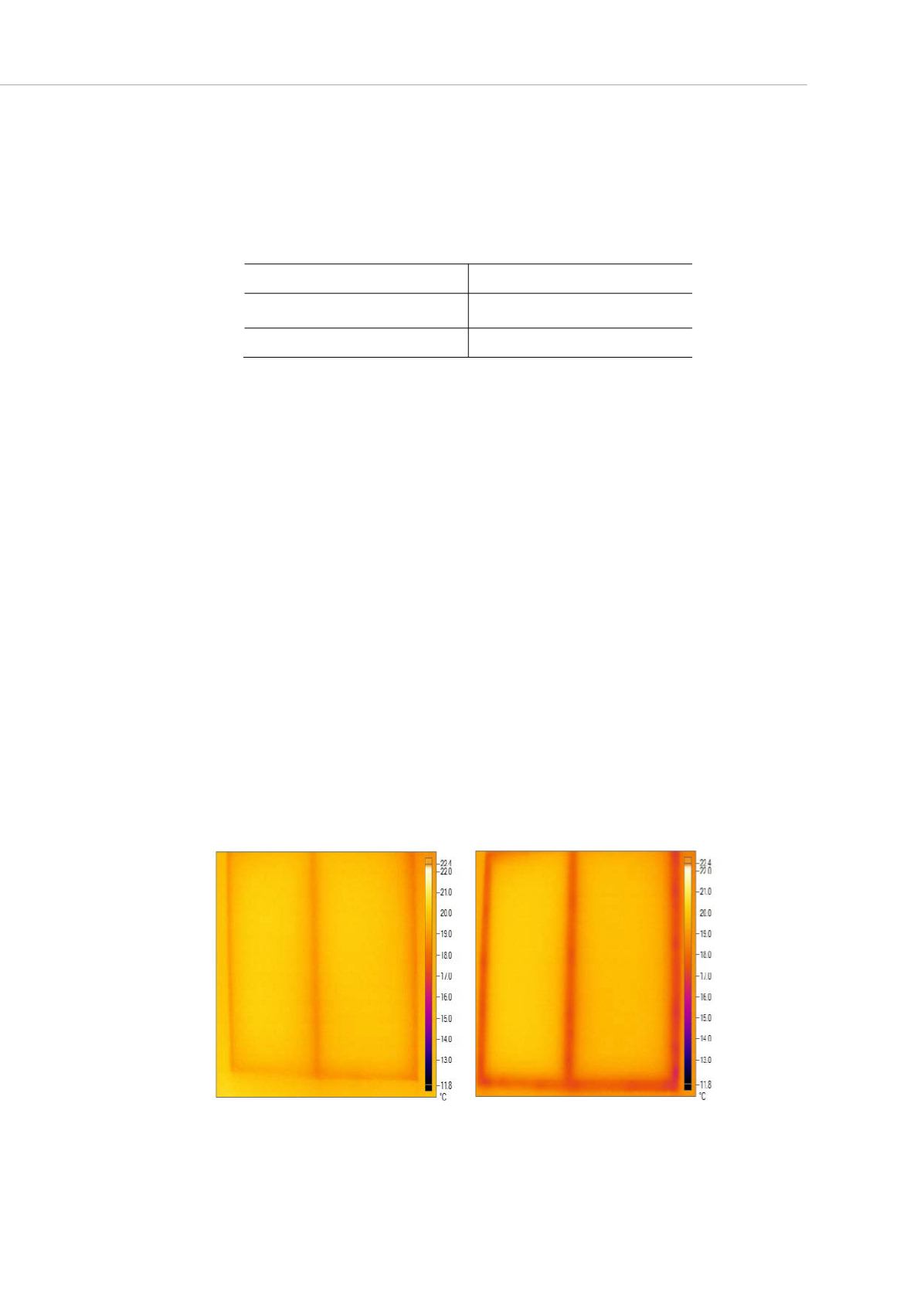
In order to confirm the thermal bridge effect at the connecting area of the VIP wall,
infrared thermographic images were taken for the VIP walls. The infrared image is
shown in Fig. 8. For both of VIP walls, it was found that the thermal bridge effect at the
connecting area of VIPs was observed. For the wooden lath type, the temperature
differences between at the centre of the VIP and at the connecting area can be clearly
recognized. Fig. 9 presents the temperature distribution of wall surface: The temperature
of the 100 mm point in the wall surface, the wooden lath type and the joiner type is about
17
℃
and 18.5
℃
, respectively. The temperature of the connecting area for the wooden
lath type is lower than that of the joiner type. This means that in respect of the thermal
bridge losses, the installation method of joiner type has better performance than the
wooden lath type.
Figure 8: Infrared images of the VIP wall of joiner type (left) and wooden lath type (right)


